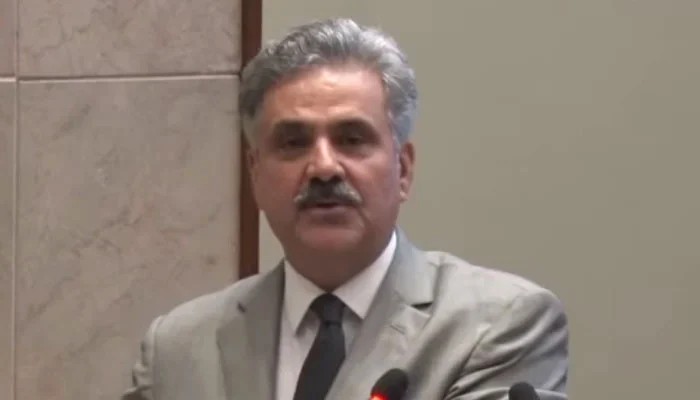
Chief Justice of Pakistan (CJP) Yahya Afridi has said that the district judiciary is the backbone of the justice system and the first formal forum where citizens experience justice, observing that public confidence in the legal framework is largely shaped at this level. In his inaugural address at the National Judicial Wellbeing Conference titled "From Reform to Recognition," held at the Supreme Court on Saturday, the CJP stressed that a responsive justice system requires not only efficient courts but also well-supported, professionally equipped, and institutionally valued judicial officers.
The conference was organized by the National Judicial Policy Making Committee (NJPMC), with a central focus on judicial wellbeing, institutional support, and performance recognition across the district judiciary. The CJP recalled that soon after assuming his high office, he visited some of the farthest and underserved districts, observing gaps between institutional arrangements and the practical needs of judges, lawyers, litigants, and court users.
These visits informed a series of reforms aimed at improving working conditions, professional resources, court infrastructure, public facilitation, and institutional support at the district level, the CJP said. He further noted that the reform program includes the solarization of court complexes, the establishment and strengthening of e-libraries, the provision of internet facilities and clean drinking water, and the creation of Women Facilitation Centres. The CJP stated that these projects have been successfully completed across Punjab, Khyber Pakhtunkhwa, Sindh, and the Islamabad Capital Territory.
Similarly, in Balochistan, the CJP said that projects have been completed in 18 districts. Implementation in the remaining districts has faced logistical challenges due to difficult terrain and the law-and-order situation; however, work is actively underway and is expected to be completed shortly. The CJP highlighted that 2026-27 has been earmarked for the Gender-Responsive Justice Initiative, with a particular focus on women litigants, adding that Women Facilitation Centres are being developed to provide essential services and support under one roof, emphasizing dignity, privacy, safety, accessibility, and a more responsive court environment.
Meanwhile, the chief justices of all high courts, along with the chief justice of the Gilgit-Baltistan Chief Court, addressed the participants. From September 2025 to July 2026, more than 1,460,000 time-bound cases were decided, while Model Criminal and Civil Courts disposed of over 133,000 cases, reflecting sustained institutional effort and commitment at the district level.