
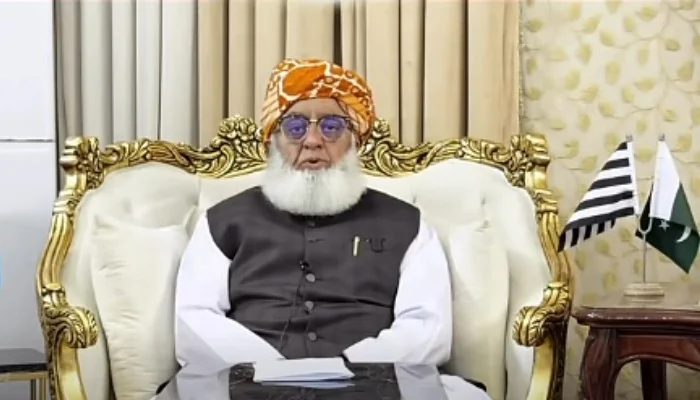
Jamiat Ulema-i-Islam-Fazl (Jamiat Ulema-e-Islam-Fazl (JUI-F)) chief Maulana Fazlur Rehman on Tuesday alleged that he was under a "state siege," claiming that police deployment outside his Lahore residence and roadblocks across the city had prevented him from attending a seminar organised by the Lahore High Court Bar Association (LHCBA). Fazl, who arrived in Lahore on Monday night, was scheduled to address an all-parties seminar at the invitation of LHCBA.
- Maulana Fazlur Rehman claims police have confined him to his Lahore residence, preventing him from attending a scheduled bar association seminar.
- The Jamiat Ulema-e-Islam-Fazl (JUI-F) has filed a petition in the Lahore High Court challenging the alleged siege and the lack of a legal detention order.
- Opposition leaders Mehmood Khan Achakzai and Allama Raja Nasir Abbas have condemned the restrictions, calling for an immediate end to the blockade.
Jamiat Ulema-e-Islam-Fazl (JUI-F) Allegations and Regional Pressure
However, according to his party, he could not leave his residence due to the deployment of police personnel in the area. In a video message, the Jamiat Ulema-e-Islam-Fazl (JUI-F) chief thanked the bar association, its president, and members for inviting him, but regretted his inability to attend the event in person. He alleged that roadblocks and checkpoints had effectively choked the city and prevented peaceful citizens from participating in intellectual discussions.
"God willing, these sieges will break and these obstacles will be removed. Oppression never achieves permanence, but patience has always enjoyed permanence throughout history," he said. Fazl said his party had always worked for peace and had put the lives of its workers at risk for the country.
He rejected the need for any certificate of patriotism from the government or state institutions, claiming that his party's loyalty to the country was beyond question. The Jamiat Ulema-e-Islam-Fazl (JUI-F) chief also alleged that party workers and office-bearers in Bhakkar, Mianwali, Khushab, and Sargodha were facing pressure ahead of the party's planned public gathering in Sargodha on Nov 26. He claimed that businesses were being shut down, shops and flour mills sealed, and party office-bearers arrested across the division to prevent the party from mobilising supporters.
Despite these restrictions, Fazl said the party was determined to hold its gathering and urged people to participate in what he described as a struggle for freedom, constitutional supremacy, the rule of law, and democracy. "We are fighting the case of the public. We are fighting the case of Pakistan. We are fighting the case of this state," he said. Referring to the party's position on mineral resources in the tribal areas, Fazl alleged that state actions against the Jamiat Ulema-e-Islam-Fazl (JUI-F) had intensified after it raised questions about the use and ownership of these resources. He maintained that natural resources belonged to the people of the respective regions and should not be treated as the property of the federation.
He added that the party would continue raising its voice for the rights of people in Khyber Pakhtunkhwa, Balochistan, Sindh, and Punjab, including Gwadar, and would take its struggle to its logical conclusion.
Lahore High Court Petition
Meanwhile, a petition challenging the alleged police siege of Fazl's Lahore residence was filed in the Lahore High Court by Jamiat Ulema-e-Islam-Fazl (JUI-F) lawyer Advocate Abrar Hussain. The petition had not yet been fixed for hearing. The petitioner alleged that around 3,000 police personnel had been deployed outside the Jamiat Ulema-e-Islam-Fazl (JUI-F) chief's residence, effectively confining him to his house. He further claimed that he had requested authorities to provide a copy of the legal order authorising Fazl's detention or confinement but was not provided with any such document. He also alleged that police had denied him permission to meet the party chief, and requested the court to direct the police to lift the alleged siege.
Opposition Response
In his statement, the Jamiat Ulema-e-Islam-Fazl (JUI-F) spokesperson warned that the arrests of party workers in various cities and alleged deployment of a heavy police contingent outside the party chief's residence would have political consequences. He said arrests, roadblocks, sealing of businesses, and registration of FIRs would not deter the party from continuing its struggle for constitutional supremacy and people's rights. In another development, Leaders of the Opposition in the National Assembly and the Senate, Mehmood Khan Achakzai and Allama Raja Nasir Abbas respectively, said political differences should be addressed not through curbs, blockades, or coercion, but through dialogue, reasoned argument, and the democratic process.
In a joint statement, they stressed that the house arrest of Maulana Fazlur Rehman and the blocking of access routes around his residence were condemnable, reflected an authoritarian approach, and must be lifted immediately. They contended that Fazl was the head of a major political and religious party and a senior national leader, making such unjust and humiliating treatment entirely unacceptable. If the government harboured any concerns or apprehensions, they stressed, these should be addressed within the framework of law and the Constitution, rather than through political pressure, intimidation, or unlawful restrictions.
They warned that such measures would exacerbate political tension rather than alleviate it, and would further erode public confidence in the democratic system. They insisted that dissent was a fundamental right in a democracy, and criminalising it while imprisoning political leadership was tantamount to pushing the country further towards instability. They demanded that Fazl's detention be ended immediately, that all routes blocked around his residence be reopened, and that he, his family, and other citizens be granted the right to freedom of movement. They warned that the relevant authorities and the government would be held responsible for the consequences of such unconstitutional and undemocratic treatment of political leadership. "Placing a political leader under house arrest · solely on the basis of political differences or disagreement with his stance · and effectively besieging his residence by blocking access routes runs counter to democratic values, political tolerance, and constitutional freedoms," they argued, adding that obstructing a citizen's free movement, restricting access to his home, and blocking paths for his family, relatives, and other citizens constituted an abuse of state power.