
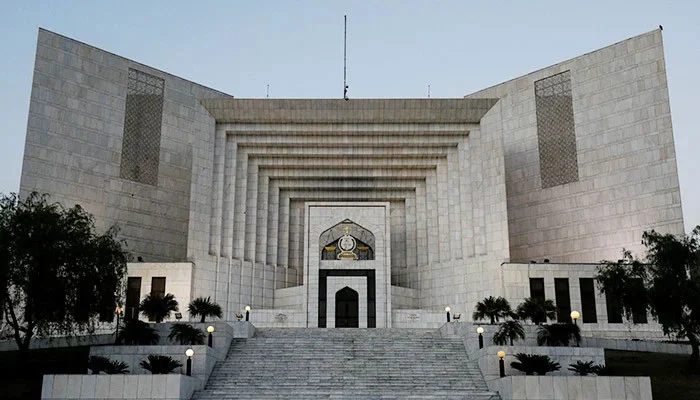
The Supreme Court (SC) has acquitted two convicts, Arshad Ali and Wajidullah, who were serving a 31-year prison sentence in an explosives recovery case. A three-member bench headed by Justice Malik Shahzad Khan and comprising Justice Aqeel Abbasi and Justice Shakeel Ahmed acquitted two accused by setting aside their sentences imposed by the Sessions Court Swabi. The order followed arguments by defence counsel Arshad Hussain Yousafzai.
Yar Hussain Police Station, Swabi, had claimed recovery of two pistols, two hand grenades and an improvised explosive device from the accused on November 17, 2013. The Sessions Court convicted them and ordered imprisonment and confiscation of property, while the Peshawar High Court dismissed their appeals. The same bench rejected the government's request for a two-week adjournment in review petitions challenging the acquittal of accused in the Baldia Town Karachi tragedy case, adjourning further hearing until Wednesday.
Additional Prosecutor General Sindh sought the adjournment, drawing thecourt's displeasure. Justice Malik Shahzad Khan said the Supreme Court should not be taken for granted and state institutions would be treated like ordinary litigants. The court observed that a review petition must identify an error in the judgment and directed that either the Prosecutor General or Additional Prosecutor General appear on Wednesday.
It made clear that no further adjournment would be granted. In another hearing, the Supreme Court has held that an employee assigned medically prescribed light duty cannot be faulted for failing to complete a field training course that was not offered to him for medical reasons, ruling that such non-completion was not wilful default and did not bar his promotion. A two-member bench comprising Justice Ayesha A Malik and Justice Aqeel Ahmed Abbasi dismissed an appeal by the Senior General Manager/CEO, Pakistan Railways Headquarters Office, Lahore, against the Federal Service Tribunal's November 12, 2024 judgment directing the department to consider Muhammad Saeed Akhtar's claim for proforma promotion as Train Supervisor (BS-11) with effect from May 31, 2019.
The Supreme Court found no legal error, procedural infirmity or misreading of the record warranting interference under Article 212(3) of the Constitution. A four-page judgment authored by Justice Abbasi noted that Saeed had been assigned light sedentary duties on the recommendation of the department's Medical Board. The court held that where an employee is assigned light duty because of medical disability, failure to complete a field training course not offered to him for medical reasons cannot be treated as wilful default.
It further held that the department could not deprive a senior employee of consideration for proforma promotion alongside his juniors. The department had argued that Saeed was rightly denied promotion for failing to complete the mandatory T-7(a) course. His counsel contended that he had been assigned light duties on medical grounds since October 4, 2007, was subsequently promoted as SAT (BS-9), performed office duties until retirement, and that the department had failed to explain why he could not be considered for BS-11 promotion while continuing on light duty.