
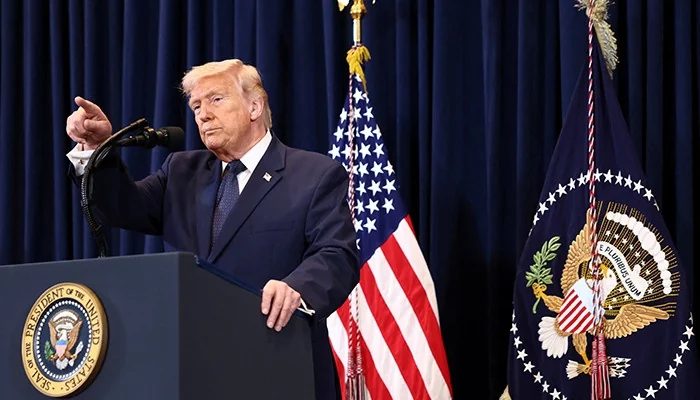
US President Donald Trump said on Thursday that the United States would see what happens with Iran after January 1, during a Fox News interview in China.
- Trump warned of potential escalation or de‑escalation with Iran.
- US Senate rejected a war‑powers resolution 51‑48.
- Four Western powers urged Iran to allow IAEA inspections.
Trump's Iran stance
During the interview, Trump answered questions about a CNN report that Iran was planning to detonate a "dirty bomb" in Washington. He said, "I don't think so," when asked if people in the capital should be alarmed, but added that Iran was "looking at" gases, biological weapons and other threats. Trump also said, "We're going to have a new year coming up, and we'll see what happens after January 1. But they've been nasty."
Iran's Foreign Ministry posted on X that U.S. accusations of chemical and biological weapons were intended to create fear and justify military action. The ministry called the CNN report "baseless."
On the same day, U.S. Senate Republicans voted 51‑48 to defeat a war‑powers resolution that had passed the House. The resolution would have directed President Trump to end the war in Iran or obtain congressional approval to continue it. The vote was largely along party lines and came weeks after sweeping defeats in the midterm elections.
UN inspectors stalled
United States, Britain, France and Germany pressed Tehran at a meeting of the UN atomic watchdog's board. They urged the Iranian government to allow inspectors to return to nuclear sites bombed by the U.S. and Israel in June 2025. The four countries said the IAEA had lost continuity of knowledge regarding Iran's previously verified stockpile of high‑enriched uranium for a year and a half.
IAEA Director General Rafael Grossi informed the board that the only inspections in the last quarter were at the undamaged Bushehr nuclear power plant. He said there was no technical reason preventing the Agency from accessing the affected facilities and that inspectors had been ready to return for a long time.
The joint statement from the four Western powers called Iran's "stonewalling strategy" and urged the country to seize the opportunity to address international concerns about its nuclear program.
Regional incidents
Iranian Revolutionary Guards Navy said that two oil tankers hit naval mines in the Strait of Hormuz, exploded and are burning. Iraqi officials announced a compromise with the Iran‑backed militia Kataib Hezbollah after Prime Minister Ali al‑Zaidi prepared security forces to move against the group. The deal would see Kataib forces relocate to other areas while government forces entered the group's stronghold of Jurf al‑Sakhar.
Saudi authorities confirmed a Houthi attack damaged a landmark tower in Riyadh's financial district. The civil defence agency said the attack caused material damage to several floors of the tower and two adjacent buildings, but no casualties. The tower, which houses the Public Investment Fund, is the second time this month that a building in the King Abdullah Financial District has sustained damage.
Later that day, residents across Riyadh received mobile alerts warning of a "hostile aerial threat," but no explosion was heard. Saudi Crown Prince Mohammed bin Salman met U.S. Central Command chief Admiral Brad Cooper in Riyadh. The two discussed bilateral relations, military affairs and regional developments.
Meanwhile, activists warned that poet Peyman Farahavar, 37, faces imminent execution after his sixth appeal against a death sentence failed. The Norway‑based NGO Iran Human Rights reported that the judiciary had issued an order for his execution.