
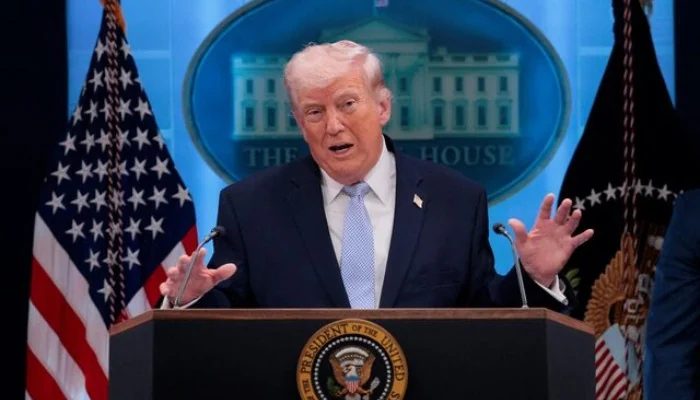
US President Donald Trump warned on Wednesday that military action against Iran must occur before the end of January, or it would be curtailed by a Democratic Congress.
- Trump said the war is funded through January.
- Iran's first vice president said naval blockade concerns were low.
- US Treasury Secretary called Iran a "sinking ship."
Trump's Time‑Limited Threat
Trump told The New York Post that the United States had funding for the war against Iran until the end of January. He warned that a Democratic majority in Congress would curtail any offensive launched after that date. Trump also said the Democrats would win the war in Iran, turning it into a loss for the United States. He added that he was concerned only with Tehran's nuclear programme, not regime change. Trump said he wanted compensation for the 75,000 protesters killed in the last seven months and that the war had started in 1979. He said he was the only president willing to go to war, but the conflict began with the Islamic Revolution that deposed the Shah.
Iran's Economic Measures
Iran's first vice president Mohammad Reza Aref said the government was not worried about a U.S. naval blockade, citing increased cargo through non‑southern borders. He added that strategic goods reserves were strong and supplies plentiful. Aref also said the government sought to keep basic goods prices stable for at least three months. President Masoud Pezeshkian announced that the state would redirect budget resources and energy savings to improve living standards in poorer communities. Consumer prices in October rose 88.7 percent year‑on‑year, while annual inflation accelerated to 76.8 percent. Food and beverage prices climbed 112.6 percent.
US‑Iran Tensions Escalate
The Iranian army's air defence force shot down two U.S. drones over the Strait of Hormuz on Tuesday night. One drone was a Lucas and the other an MQ‑9. In a separate operation, an advanced U.S. MQ‑9 drone was targeted and destroyed by indigenous air defence systems over the eastern part of the waterway. The Islamic Revolutionary Guard Corps Navy reported that two oil tankers violated maritime regulations in the Strait of Hormuz, struck naval mines, and suffered explosions and fires.
Iranian Air Defences
At a United Nations Security Council meeting, Iranian Ambassador Gholamhossein Darzi warned that the United States used artificial intelligence to plan and carry out attacks. He said U.S. forces deployed more than 2,000 munitions to hit 2,000 distinct targets within 96 hours, using Palantir's Maven and Anthropic's Claude system to analyse intelligence and provide strike coordinates. Darzi said neither advanced technology nor private companies could shield the United States or the Israeli regime from accountability for violations of international law.
Israel's Chemical Weapon Claims
Iranian Foreign Minister Abbas Araghchi posted on X that Israel was attempting to drag the United States into another war after an Israeli minister alleged Tehran was building chemical weapons. Israeli Defence Minister Israel Katz also alleged Tehran was building chemical weapons and vowed to stop Iran from obtaining them. Avigdor Liberman wrote on X that caretaker Prime Minister Benjamin Netanyahu and Defence Minister Israel Katz had a lust for power and that there was no justification for an independent Israeli attack in the immediate term.
US Treasury Critique
U.S. Treasury Secretary Scott Bessent called the Iranian regime a "sinking ship" in a brief social media post. He said Iran had failed to load a single oil tanker since the Treasury launched Operation Economic Outcast in August, an unprecedented campaign against Iran and its enablers. Bessent added that Iran had no oil left to sell on the water.
Houthis Attack
Houthi military spokesperson Yahya Saree said the Houthi militia had attacked Saudi Arabia's Ras Tanura oil refinery, causing fires. Satellite imagery from NASA and Planet Labs showed thick black smoke over the installation. A projectile fired by the Houthi militia struck Jazan port in southwestern Saudi Arabia.