
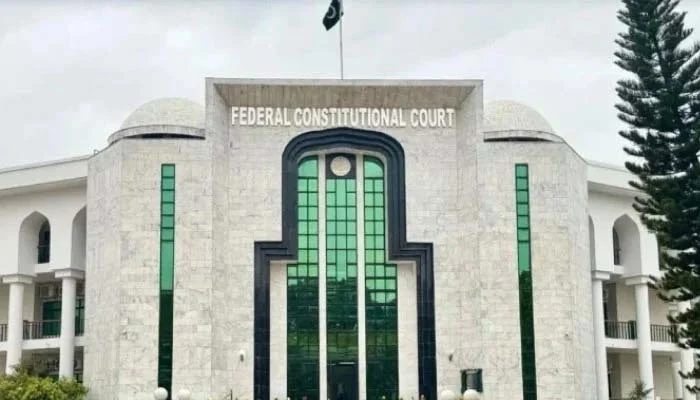
The Federal Constitutional Court (FCC) has ruled that a person who does not meet the eligibility criteria of a housing scheme cannot claim a legal, vested or enforceable right to a flat or house merely because his name was declared successful in a computerized ballot. A two-member bench comprising Chief Justice Aminuddin Khan and Justice Ali Baqar Najafi gave the ruling while deciding cases concerning the allotment of 2,100-square-foot high-rise flats in Hayatabad Phase-V, Peshawar, and dismissed the petitions and a criminal appeal with costs.
In its detailed judgment, the court held that the eligibility conditions specified in the housing scheme's The computerised ballot was only a method of selecting successful applicants from among those who already fulfilled the eligibility requirements. Being successful in the ballot, it said, could not make an otherwise ineligible applicant eligible. The court noted that the petitioners were federal government employees at the time of the ballot and did not meet the scheme's eligibility criteria.
Their selection through the ballot therefore had no legal effect, and an administrative error could not create a right that did not otherwise exist under the law or the scheme's conditions. The FCC held that a public authority was not obliged to perpetuate an illegality merely because the error had been committed by its own officials. Once an erroneous allotment was discovered, it was the authority's legal duty to rectify it.
Allowing ineligible applicants to retain allotments in a scheme involving limited public resources merely because of an administrative mistake would be unfair to applicants who fulfilled the prescribed criteria, the court observed. It further held that cancellation of the allotments did not deprive the petitioners of any vested or accrued legal right but amounted to correction of an administrative error. The court noted that the authorities had reconsidered the matter, provided the petitioners an opportunity of personal hearing and, after obtaining the Advocate General's opinion, a special committee unanimously decided on December 14, 2021 to cancel the allotments.
The FCC held that the requirements of natural justice had been met, explaining that an opportunity of hearing did not mean that the explanation offered by a party had to be accepted. The judgment also clarified that no legitimate expectation could arise from an administrative error contrary to law, nor could the doctrine of estoppel prevent a public authority from correcting such an error. The court also dismissed a criminal appeal relating to contempt of court, holding that an earlier Peshawar High Court judgment had not declared the petitioners eligible under the housing scheme.
Since the authorities had reconsidered the matter in light of the High Court order and cancelled the allotments after giving the petitioners an opportunity of hearing, there was no wilful disobedience. Finding no legal or procedural defect in the authorities' action, the FCC declined to interfere with the Peshawar High Court judgment and dismissed all the petitions and the criminal appeal with costs.