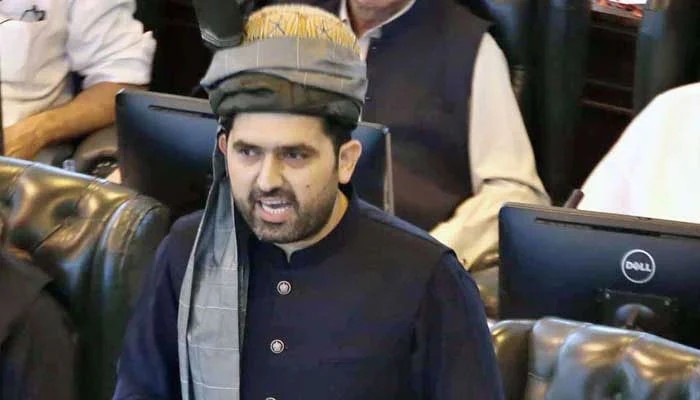
Khyber Pakhtunkhwa Chief Minister Sohail Afridi on Saturday dismissed reports about his possible removal as baseless, saying only Pakistan Tehreek-e-Insaf (PTI) founder chairman Imran Khan could decide his political future, and warned that any attempt to remove him could trigger a strong public reaction. Speaking to journalists at the Chief Minister's House, Afridi said he had been brought into the provincial leadership by Imran Khan and would accept whatever decision the PTI founder took.
"Imran Khan brought me here and only Imran Khan can remove me," he insisted. "When Imran Khan gives a protest call, the party leadership cannot ignore it," he said in response to certain media reports from the PTI leaders saying Sohail Afridi had not taken them into confidence before giving the call for a long march on August 5, 2026. Asked about Jamiat Ulema-e-Islam Fazl (Jamiat Ulema-e-Islam-Fazl (JUI-F)) chief Maulana Fazlur Rahman, Chief Minister Afridi said the PTI leadership was in contact with him.
He said that if Fazlur Rahman wanted to participate in the protest, the party would welcome him and stand with him. The chief minister claimed preparations for the mobilisation had been completed, saying workers were ready despite what he described as threats and intimidation. He said vehicles had been arranged and a large number of motorcycles would also be a part of the mobilisation.
The chief minister said PTI had spent nearly two months pursuing what he described as legal, democratic and constitutional avenues before taking the street route. He said he had approached the National Assembly, written to the Punjab government and contacted the prime minister seeking a meeting. "I was told that I would be informed after the matter was discussed," he said.
He also said that when the chief justice of Supreme Court was in Islamabad, he went to meet him, but claimed that despite approaching different constitutional and legal forums, his requests were not heard. The chief minister said the party, therefore, ultimately announced the protest call, adding that he had given around 52 days between the announcement and the proposed mobilisation. He said the demands centred on the cases against Imran Khan being heard on merit and in accordance with law, provision of medical treatment to the PTI founder at Shifa International Hospital in the presence of his sisters and implementation of court orders allowing his family, lawyers and political representatives to meet him.
Afridi referred to court directions concerning weekly meetings with Imran Khan, saying that the orders were required to be implemented and that doing so could not be described as unconstitutional or illegal. On the provincial economy, Afridi claimed his government had substantially increased revenue without imposing new taxes. He said provincial revenue had been around Rs64 billion over a period of roughly 76 years, while the previous year's target was Rs93 billion and was achieved.
The chief minister claimed that after assuming the chief minister's office, his government had raised revenue to around Rs150 billion within eight to nine months without imposing new taxes. He said the province had previously set a revenue target of Rs129 billion and that he had now set a target of Rs180 billion for a single year without introducing new taxes. The chief minister also spoke at length about alleged irregularities in development projects worth Rs60 billion, particularly those involving the World Bank and Asian Development Bank.
He said that while serving as provincial communications and works minister, he had detected what he described as corruption and irregularities in some projects and had informed then-chief minister Ali Amin Gandapur. After becoming the chief minister, he said, he changed the project directors concerned and directed them to examine all relevant documents on merit and report any misappropriation. According to Afridi, the subsequent scrutiny identified one federal minister, one senator and two other individuals whose work orders and related documents were allegedly found to be fake.
He said action was taken and those involved were told that they would face the consequences. He also alleged that the federal minister and senator subsequently approached the World Bank. He said he instructed project directors and other officials to stand by their staff if their work was lawful, arguing that nobody could take action against them if they had followed the rules.
He alleged that the federal government delayed the matter for four to five months and that, following threats, financial approvals were eventually granted to the individuals concerned, while companies objected to by the provincial side were removed. He said relations between Pakistan and Afghanistan had not been ideal even during Imran Khan's government and Ashraf Ghani's tenure, but maintained that the approach at the time had been comparatively better.
The chief minister argued that the closure of the border was particularly damaging for the tribal districts, whose economies and livelihoods were closely linked with cross-border trade. He put the value of economic activity associated with the border at around Rs10 billion and claimed that losses during the current year had already reached around Rs7 billion within a few months. In his view, better relations with Afghanistan would make it easier to address security concerns, while hostile relations would continue to create difficulties.
He called for a uniform policy towards terrorism, saying that any person carrying a weapon in civilian clothes should be treated in the same manner, regardless of whether the person was described as "good" or "bad". He said anyone attacking civilians or security personnel was a terrorist and argued that more than two decades of military operations had not brought lasting peace to the province.