
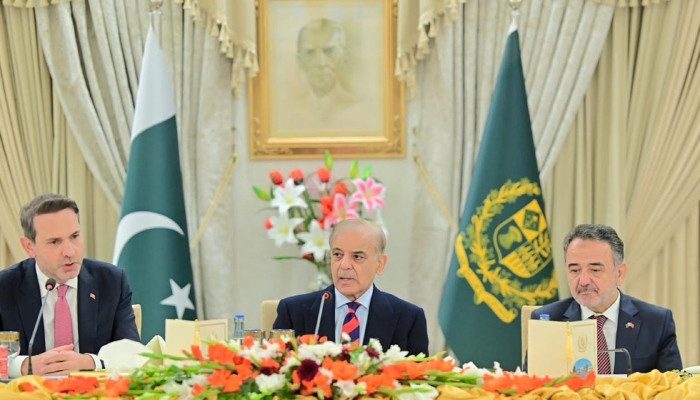
Prime Minister Muhammad Shehbaz Sharif said on Friday that the exploration of potential oil and gas reserves in Pakistan's maritime boundaries is an important step for the country's energy security and economic development. "We are grateful to Turkish President Recep Tayyip Erdogan for the arrival of Turkish research vessel Oruc Reis to Pakistan and for its full cooperation in the offshore oil and gas exploration project," he said at a dinner reception hosted in honour of Turkish Minister of Energy and Natural Resources Alparslan Bayraktar and the Turkish delegation.
- Prime Minister Muhammad Shehbaz Sharif emphasized that exploring potential oil and gas reserves in Pakistan's maritime boundaries is crucial for energy security and economic development.
- The Turkish research vessel Oruc Reis arrived in Pakistan to conduct a 3D seismic survey for about two months in the maritime areas of Sindh and Makran.
- Petroleum Minister Ali Pervaiz Malik noted that Pakistan launched a competitive offshore bidding round, attracting bids for 23 blocks covering approximately 53,510 square kilometres.
Speaking on the occasion, the prime minister said Pakistan's historical relations with the brotherly country of Turkey are based on long-standing friendship, mutual trust, brotherhood and common interests. He welcomed the growing cooperation between Pakistan and Turkiye in the energy sector. He said Pakistan wanted to further expand cooperation in the energy sector by utilising Turkiye's experience and technical expertise.
In addition to offshore oil and gas exploration, there were vast possibilities to enhance bilateral cooperation in the fields of minerals and renewable energy, he said, adding, "Exploration of potential oil and gas reserves in Pakistan's maritime boundaries is an important step for the country's energy security and economic development." Turkish Energy Minister thanked the Prime Minister for the warm welcome and exemplary hospitality extended to him and his delegation in Pakistan.
"With the arrival of Turkish research ship Oruc Reis in Pakistan, cooperation in the energy sector between Pakistan and Turkey is entering a new era," he said, adding, "Turkey is committed to utilizing its technical expertise, scientific experience and engineering capabilities for the benefit of Pakistan." The minister said Turkish research ship Oruc Reis will conduct a 3D seismic survey for about two months to explore potential oil and gas reserves in the maritime areas of Sindh and Makran.
"The scientific data obtained under the project will be helpful in determining the possibilities of oil and gas exploration and drilling in the future," he remarked. The Turkish delegation included Ali Shaheen, Member of Turkish Parliament and President of Pakistan-Turkey Friendship Group, Turkish Ambassador to Pakistan Irfan Neziroglu and senior officials from the Turkish Ministry of Energy. Deputy Prime Minister and Foreign Minister Senator Muhammad Ishaq Dar, Federal Ministers Junaid Anwar Chaudhry, Attaullah Tarar, Ali Pervaiz Malik and Sardar Owais Ahmed Khan Leghari, Advisor to the Prime Minister Muhammad Ali, and Special Assistants Tariq Fatemi and Lieutenant General (R) Muhammad Zafar Iqbal were also present at the dinner.
Offshore Exploration Policy and Markets
Earlier, Pakistan and Turkiye entered a new phase of strategic energy cooperation with the arrival of Turkiye's seismic research vessel Oruç Reis at Karachi Port. Addressing a welcome ceremony at Karachi Port, Deputy Prime Minister and Foreign Minister Ishaq Dar described the vessel's arrival as a milestone in bilateral scientific and strategic cooperation, saying both countries were committed to building a long-term partnership in the energy sector.
He said Pakistan's coastline offered considerable opportunities for offshore energy exploration, shipping and fisheries, but stressed that sustainable development required scientific research, skilled manpower and environmental protection. Dar said the seismic survey would combine Turkiye's technical expertise with the capabilities of Pakistani energy companies to improve understanding of geological structures beneath the seabed and guide future exploration decisions. He cautioned, however, that seismic surveys did not guarantee commercially viable discoveries but were an essential first step in identifying potential hydrocarbon resources.
He said Pakistan wanted to broaden energy cooperation with Turkiye beyond offshore exploration to include minerals and renewable energy, while encouraging collaboration among geologists, engineers, universities and research institutions of the two countries. Referring to Prime Minister Shehbaz Sharif's recent meeting with Turkish President Recep Tayyip Erdogan in Antalya, Dar said the two leaders had agreed to accelerate cooperation in trade, investment, defence, energy and regional connectivity.
The prime minister had also directed relevant institutions to improve coordination and prevent unnecessary delays in strategically important projects. "Our seas are an economic asset, but they are also a national trust. Development and environmental protection must go hand in hand," Dar said.
Energy Institutions and Rates
Petroleum Minister Ali Pervaiz Malik said the arrival of Oruç Reis had transformed bilateral energy agreements into practical cooperation, marking an important step towards reviving offshore exploration in Pakistan. He said Pakistan's offshore basins held significant geological potential, although large areas remained underexplored. Emphasising the importance of technology and investment, he said expectations alone could not reveal the resources beneath the sea.
Malik recalled that Pakistan had launched a competitive offshore bidding round last year after a gap of 18 years, attracting bids for 23 blocks covering approximately 53,510 square kilometres. He said Turkiye's participation had significantly expanded bilateral petroleum cooperation through agreements covering three offshore and two onshore blocks. The Eastern Offshore Indus-C Block is at the centre of the initiative.
Turkish Petroleum Overseas Company (TPOC), a wholly owned subsidiary of the Turkish Petroleum Corporation (TPAO), is the operator with a 25 per cent working interest. Pakistan Petroleum Limited (PPL) holds 35 per cent, Oil and Gas Development Company Limited (OGDCL) 20 per cent and Mari Energies Limited the remaining 20 per cent. Malik said the seismic data would provide a clearer picture of subsurface geological formations, reduce exploration and drilling uncertainty.