
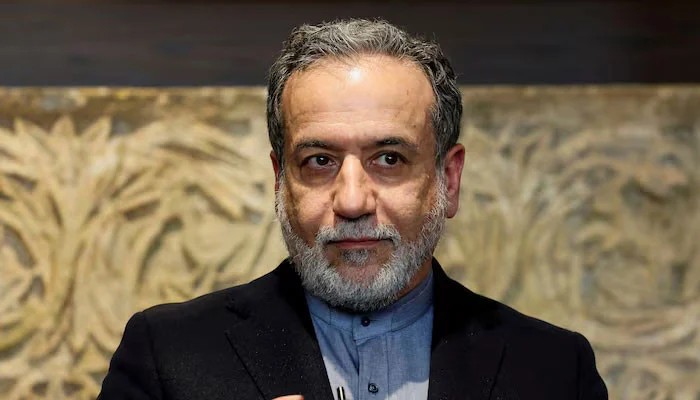
TEHRAN/ WASHINGTON: Iran's Foreign Minister Abbas Araghchi said Tuesday there had been "significant progress" in talks with Oman over the administration of the strategic Strait of Hormuz. According to an Iranian foreign ministry statement, Araghchi "explained the latest status of Iran-Oman talks on the Strait of Hormuz, reporting significant progress" during a call with his Japanese counterpart. Iran and Oman, both coastal states on the strait, have for weeks been discussing the future of navigation through the waterway, with Tehran saying progress had been made to agree a temporary shipping route.
President Masoud Pezeshkian, pointing to a less conciliatory tone from Tehran, said on Tuesday that Iran will continue its resistance with strength until "aggressors" become regretful and its rights are defended. "The Islamic Republic of Iran has always been against war and has considered the preservation of people's interests and regional security to lie in refraining from conflict. However, just as it has boldly risen to defend against aggression up to this day, it will continue this resistance with strength until aggressors become regretful and will remain guardian of people's rights," Pezeshkian posted on X.
A Qatar foreign ministry spokesperson said on Tuesday that Qatar is working with partners in the region and around the world, including China, to resume talks between the United States and Iran. Qatar's Prime Minister and Minister of Foreign Affairs Sheikh Mohammed bin Abdulrahman Al-Thani is currently leading a delegation in Beijing. The United States imposed sanctions Tuesday on "all remaining Iranian airlines" that have yet to face such penalties, as Washington pushes to step up economic pressure in its war with Tehran.
The US Treasury Department said its latest action takes aim at "36 targets for supporting Iran's aviation sector, which the regime uses to move weapons, personnel, and illicit cargo." These include 27 Iranian airlines, alongside firms based in countries such as the United Arab Emirates, Turkey, Malaysia and Kazakhstan. "Essentially, we're taking the entire aviation sector of the Iranian economy out of the market," a US Treasury official told reporters on condition of anonymity.
US Treasury Secretary Scott Bessent has vowed the United States is declaring an "economic D-Day" on Iran, pledging to choke Tehran off financially. "Under Operation Economic Outcast, we promised severe consequences for those providing financial lifelines to the Iranian regime," Bessent said Tuesday in a statement. He warned that anyone doing business with Iran's remaining airlines risk being cut off from the global financial system.
Besides Iranian airlines, the Treasury Department said its latest actions target third-country firms that "facilitate US-sanctioned Mahan Air's proliferation activity, terrorist-linked flight operations, and illicit procurement of US-origin aircraft." It is also taking aim at "cargo service providers and general sales agents that have serviced Mahan Air's international flights." Mahan Air is an Iranian airline accused of facilitating activities by Tehran's Islamic Revolutionary Guard Corps (IRGC).
On Tuesday, Mohsen Rezaei, the secretary of Iran's Supreme National Security Council, reissued dual economic and military threats on X. "In recent days, Washington has received a clear warning from Iran's new missiles. Economic warfare will be met by a maritime exclusion zone across the Persian Gulf to the blockade perimeter.
The operational posture toward U.S. warships and bases has been fundamentally recalibrated," Rezaei said. Rezaei was likely referring to the Qassem Basir ballistic missile that Iranian media reported was fired at US warships near the Strait of Hormuz.
The US military said its warships evaded any missile attacks. South Korea said Tuesday it had sent a fact-finding team to assess the situation in the Strait of Hormuz, stressing no decision had been made about potential troop deployment to the strategic waterway. Traffic through the vital shipping route has been virtually paralysed since the US-Iran war began on February 28, disrupting global energy markets.
"The team was sent to examine the regional situation and security conditions, and its mission does not presuppose an actual deployment," it said. US President Donald Trump has repeatedly pressured ally South Korea to provide help for the war in the Middle East, but Seoul denied that ally Washington had asked it to deploy troops by a specified deadline. The fact-finding team left for the United Arab Emirates over the weekend and was assessing operational conditions for a potential deployment, Yonhap News Agency reported, citing officials.
The team is expected to return to South Korea as early as this week, the report said. Iran's Revolutionary Guards on Tuesday said they seized an American submarine drone in the strategic Strait of Hormuz, which Tehran has blockaded in the months-long Middle East war. "The IRGC naval forces captured one of the most modern, unmanned, and smart submarines of the US terrorist army at the entrance to the Strait of Hormuz in a complex intelligence and operational action at dawn today," the Guards said in a statement carried by state TV.
"This smart submarine is equipped with the latest technology in the subsurface field in the world, which was delivered to the US terrorist army fleet in 2025," the statement added. "This submarine has now been captured and images of it will be released in the coming hours." World oil prices climbed Tuesday, once more closing in on $100 a barrel, and stock markets mostly retreated owing to a flare-up in the Middle East war.