
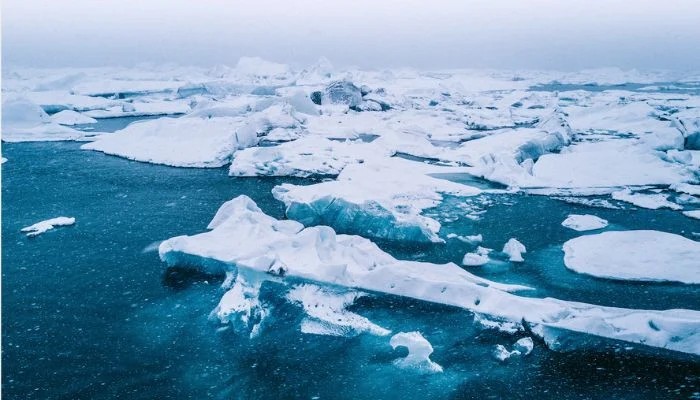
In the second week of August, two announcements arrived from opposite ends of the Arctic and told the same story. On August 10, the U.S. National Oceanic and Atmospheric Administration said it would stop producing the Arctic Report Card (the two-decade-old assessment that more than 100 scientists worldwide had used to track the region's warming). Two days later, the Chinese container ship 'Istanbul Bridge' left Ningbo on the first sailing of a new scheduled service through Russia's Northern Sea Route (NSR) to Felixstowe, England, cutting a 40-day voyage to roughly 20. One government was pulling back from measuring the Arctic, another was moving to exploit it. Between those two facts sits the defining story of the region: a rapidly melting ocean is being converted, in real time, into contested territory.
The physical transformation is not in dispute. The Arctic sea ice hit its winter maximum on March 15, 2026, at 14.29 million square kilometers, statistically tied with 2025 for the lowest in the 48-year satellite record, according to the National Snow and Ice Data Center (NSIDC). As per NSIDC data, winter maximums have been declining at a rate of about 2.5% per decade. That retreat is precisely what makes the NSR commercially attractive: Chinese shipping firms Sea Legend Line and Haijie Shipping both launched Arctic-Europe container routes this August, with Sea Legend planning eight sailings through early October 2026. China's vessels are for the first time navigating using predictive ice data from China's own Ministry of Transportation rather than relying on Russian observation, a capability built through years of polar research investment.
Russia, meanwhile, is testing the route's outer limits. A convoy of tankers carrying roughly 6 million barrels of crude was moving toward Asia along the NSR as of mid-August, nearly half the volume shipped through the entire 2025 season, escorted by nuclear-powered icebreakers running north of 81.5°N, usually far from the ice pack. The trade is partly a workaround: Ukrainian drone strikes have hammered Russian shipping in the Black Sea and Sea of Azov, pushing Moscow's oil exports northward, with China as the primary buyer. Underneath the shipping lies resource competition. Geological Survey estimates the Arctic holds roughly 13% of the world's undiscovered conventional oil and 30% of its undiscovered natural gas, alongside lithium and rare-earth deposits believed to lie beneath Greenland's ice sheet.
That mineral wealth explains much of the pressure Washington has placed on Copenhagen. U.S. President Donald Trump told reporters in January that he and NATO Secretary General Mark Rutte had agreed on the 'framework of a future deal' covering Greenland and 'the entire Arctic region,' after threatening tariffs on eight European states. Danish Prime Minister Mette Frederiksen has held the line that Denmark will negotiate security and investment but not sovereignty, while Greenlandic lawmaker Aaja Chemnitz stated that NATO has no right to negotiate over Greenland's resources without Greenlandic participation. The seven Arctic NATO members have since closed ranks, emphasising their expanding role in regional defence and polar infrastructure.