
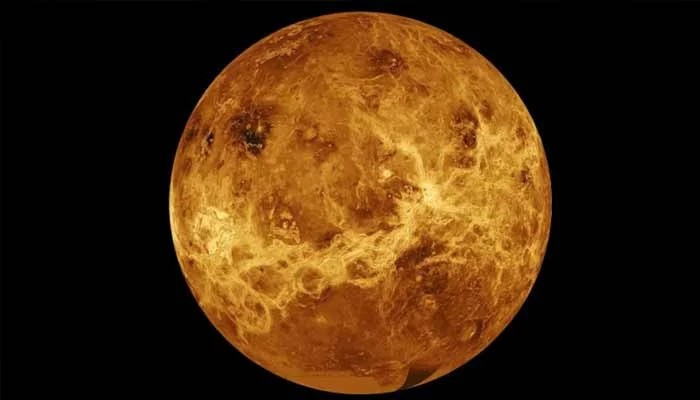
A California-based astrophysicist presented a new theory on Monday to explain why Venus, the planet most like Earth in size, mass and structure, lacks its own moon. Call it a case of celestial cannibalism. The extremely slow speed at which Venus rotates on its axis would have doomed any natural satellite that may once have orbited that planet to gradually spiral closer to its parent and ultimately be consumed in a cataclysmic smash-up.
So goes the theory offered by scientists at the University of California, Riverside, and published on Monday in The Astrophysical Journal, marking a departure from past explanations for why Venus, the second planet from the sun, is without a lunar companion. "If it had a moon, and it likely did at some point, it could not have kept it," astrophysicist Stephen Krane, lead author of the study, told reporters. "That moon would have crashed down on the planet in a relatively short time scale."
Krane said data from computer models based on planetary physics and simulating the gravitational mechanics of hypothetical Venusian moons of various sizes showed them all meeting the same fate - sooner or later collapsing into their mother planet. Such a presumed moon-gobbling event likely occurred within the first billion years in the history of Venus, which like the rest of the solar system dates back about 4.5 billion years, Krane said.
Scientists previously theorised that Venus, known as Earth's "twin," either never acquired its own moon to begin with, or possibly had a moon that was obliterated in the massive impact from another celestial object. The UC Riverside study, focusing on Earth-moon dynamics, found that planetary rotational speed was the key factor.