
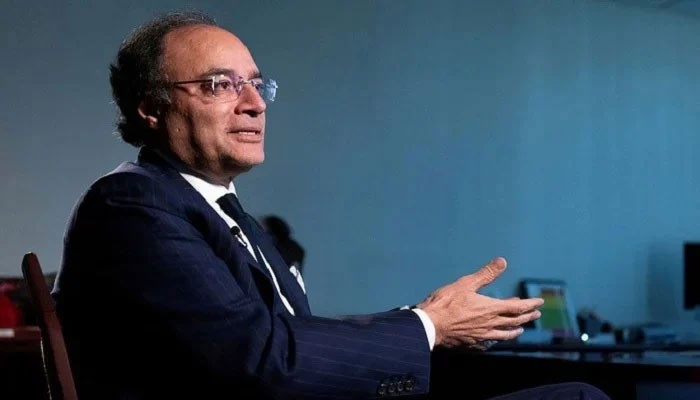
Finance Minister Muhammad Aurangzeb has said disruptions involving the Strait of Hormuz and Bab al-Mandab, along with their impact on regional energy routes and the East-West pipeline, have reinforced the need for strong fiscal and external buffers for Pakistan's economy. Addressing the 9th Leaders in Islamabad Business Summit (LIIBS) 2026, themed 'The Next Move', via video link, Aurangzeb said the government will protect recent gains while pursuing reforms aimed at private-sector-led investment and growth.
He highlighted key priorities including maintaining macroeconomic stability, shifting towards investment-, productivity- and export-led growth, pursuing structural reforms, moving from aid to trade and investment, and positioning Pakistan to benefit from the 'new economy'. Aurangzeb said maintaining macroeconomic stability remained central to Pakistan's economic future, with adequate fiscal and external buffers needed to withstand domestic and external pressures. The minister said Pakistan's GDP grew by around 3.7 percent in the last fiscal year, while economic activity remained positive in the current fiscal year.
The State Bank of Pakistan has projected growth of 3.5-4.5 per cent for the current fiscal year. He said exporters are being provided refinancing at 4.5 percent despite the policy rate of 11.5 percent, as part of efforts to support export competitiveness.On fiscal management, Aurangzeb said that the against budgeted Rs8.2 trillion for debt servicing during the last fiscal year, while actual expenditure was Rs6.9 trillion.
Reforms in public finance and domestic debt management are aimed at improving the efficiency of public resources and reducing financial risks, he added. On taxation, he said Federal Board of Revenue (FBR) revenues have increased by around 40 percent over the past couple of years, mainly through efforts to deepen the tax net, but further work is needed to broaden the tax base. He said the FBR's new operating model will shift income-tax and sales-tax processes towards a faceless system, with a pilot scheduled for October 1.
The objective is to reduce discretionary powers of tax officers and restore public confidence in the tax authority, he added. Aurangzeb said 27 state-owned enterprises have been handed over to the Privatisation Commission, while entities including Utility Stores Corporation, PASCO and PWD have either been closed or are being wound up. He also highlighted pension reforms under which new entrants to the civil government are being shifted towards defined-contribution schemes, while similar discussions are under way for the armed forces.
Aurangzeb described Pakistan's recent $3 billion international bond issuance as an important milestone, marking the country's return to international capital markets after a four-year gap. He said orders from investors are nearly twice the amount sought, with strong participation from Asian investors. The minister said Pakistan is moving away from aid-based relationships towards stronger trade and investment flows, with greater emphasis on commercial ties with bilateral partners, attracting private capital and integrating the economy with regional and global markets.
He identified the new economy as another area of opportunity, saying domestic investors needed to become more active before the country could attract greater foreign investment."Once you get the basic hygiene, you first need to get the local investors moving," he said, adding that attracting foreign investors will remain difficult without confidence among domestic investors in the direction of the economy. Muhammad Ali, federal minister and adviser to the prime minister on privatisation, said Pakistan needs to move beyond being a consumer of technology and develop businesses capable of competing globally.
He also called for stronger education, greater workforce participation and development of skills for manufacturing, defence and emerging technologies. Bilal Azhar Kayani, minister of state for finance and railways, called for structural reforms, better governance and closer coordination between federal and provincial governments. He also stressed the need to increase exports and improve access to finance for the agricultural sector and SMEs.
In the closing session, former caretaker prime minister Anwaarul Haq Kakar said Pakistan's security challenges need to be addressed, but argued that structural economic constraints also need attention. Countries facing serious violence, he noted, have continued to develop large export economies. Senator Dr Musadik Malik, federal minister for climate change and environmental coordination, stressed the need for policy continuity, a level playing field and merit-based policies.
He said addressing elite capture and reducing barriers for students and skilled people are necessary for economic development.