
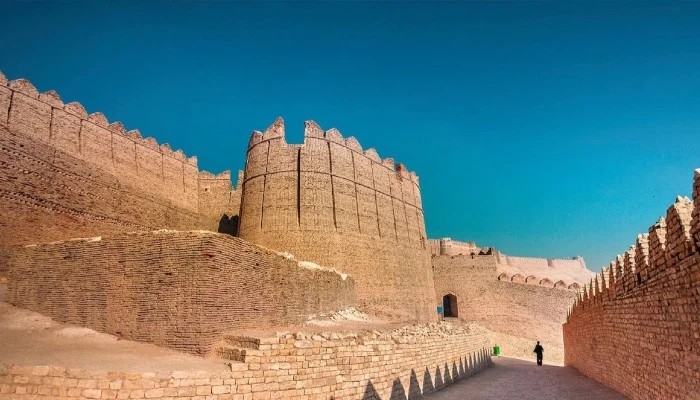
In the current discussion of new provinces and administrative divisions, references often turn to the history of Sindh. - which is why this is an opportune time to review it. In 1591-1592, Mughal Emperor Akbar defeated the Turk ruler of what is now much of Sindh and parts of Balochistan and southern Punjab, Mirza Jani Beg Tarkhan, bringing the territory under his realm.
The Mughals often ruled areas within their empire through imperial officials, appointed governors, local chiefs and tributary rulers who paid tribute (or taxes). In Upper Sindh, the Daudpotras (who later ruled Bahawalpur) were military governors under Mughal suzerainty. However, the leaders of the Kalhoro tribe, which had a significant Sufi following that they had turned into a militia, had many battles with the Daudpotras and eventually, in 1701, the Mughals recognised the Kalhoros as the rulers of Upper Sindh (including Larkana and Shikarpur) under their suzerainty.
Mian Yar Mohammad Kalhoro was given the title of Khuda Yar Khan and formal administrative control or 'ijara' over the area. His successor, Mian Noor Mohammad Kalhoro, gradually extended his rule into central and lower Sindh, and in 1736 the Mughals recognised the Kalhoro dynasty as rulers of the entire province, extending down to Thatta. This was the first time an indigenous Sindhi family ruled most of present-day Sindh.
The Samma Rajputs had ruled Sindh after 1351, and before them, the Soomras (under Mohammad Shah Tughlaq's Delhi Sultanate's suzerainty), but some of the eastern, northeastern and southern parts - including Karachi - were missing. The Kalhoros were great patrons of arts and literature and Shah Abdul Latif Bhittai's famous Shah Jo Risalo was also composed in their period. However, after the Battle of Halani in 1783, the Baloch tribe of Talpurs established their rule in Sindh.
The Talpurs had been military commanders under the Kalhoros, but after the murder of some Talpur military commanders, they rebelled and overthrew the Kalhoros. The Talpurs eventually developed three principal ruling houses. Mir Fateh Ali Talpur established the Shahdadpur branch and ruled Lower Sindh with Hyderabad as its capital.
(The city of Hyderabad was established by the Kalhoros when they moved their capital there from Khudabad, near present-day Dadu). Mir Tharo Khan founded the Manikani branch and ruled Eastern Sindh (Mirpurkhas and parts of Thar) and the Sohrabani branch in Upper Sindh (Khairpur) was founded by Mir Sohrab Khan. In 1795, the Shahdadpur branch of Talpur Mirs captured Karachi from a consortium of merchants who were running Karachi under the protection of the Khan of Kalat.
Prior to 1729, Karachi had been a Baloch and Katchi fishing village. After a nearby port at the mouth of the Hub River silted up, this consortium of Sindhi and Gujarati merchants, led by the Sindhi merchant Bhojo Mal, shifted their operations to Karachi's natural harbour and made it a self-contained port city. However, they paid tribute/duties to the Kalhoros, including when they made a fortified centre in the city.
This fortified area had two gates - Methadar and Kharadar - names that exist to this day. The Indian invasion by Nadir Shah resulted in many battles between the Kalhoros and the Khan of Kalat. In one of the battles, the then Khan of Kalat, Mir Abduallah Khan, was killed.
Subsequently, in 1745, Karachi was given by the Kalhoros to the Kalat Khanate as a settlement for the killing of the Khan. The merchants' port operations continued, but now under the protection of the Kalat Khanate, until the Talpurs took it 50 years later. In 1839, the British captured Karachi from the Shahdadpur Talpurs.
With the British came modern port infrastructure and operations, and to support and benefit from them, many merchant communities settled in Karachi, including Sindhis, Kutchis, Gujaratis, Parsis, Bhoras, and Ismailis. By the year 1890, Karachi's port was shipping more wheat than Bombay. In 1843, in the Battle of Miani, the British defeated the Hyderabad Talpurs and a little later they defeated the Mirpurkhas Talpurs in the Battle of Dubbo.
In both battles, the Khairpur-based Sohrabani branch of the Talpur Mirs aided them. This branch was rewarded by the British by letting them keep their rule intact and indeed the Khairpur princely state survived until 1955. (A popular historical anecdote is that Charles Napier sent a one-word message to Britain saying "peccavi" - Latin for "I have sinned" - after he captured Sindh.
However, this pun was actually coined by a British magazine). Our interior minister, Mohsin Naqvi, now wants to go back to the Talpur period, when Sindh was divided into three adversarial administrative branches. Or perhaps to the period between 1839 and 1843, when Sindh was divided into three administrative regions and Karachi was ruled directly by the British Empire.