
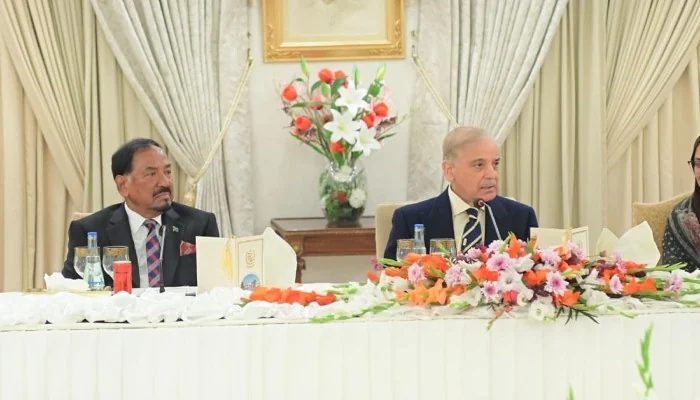
Bangladesh Parliament Speaker Hafiz Uddin Ahmad Bir Bikram stated on Wednesday in Islamabad that Bangladesh is a victim of India's water violence.
- Speaker Hafiz Uddin Ahmad Bir Bikram accused India of trying to desertify northern Bangladesh through water bullying.
- He called former prime minister Sheikh Hasina a dictator and described her Awami Party as a terrorist organization.
- President Asif Ali Zardari met the six-member Bangladeshi parliamentary delegation at the Aiwan-e-Sadr.
Bikram alleges Indian water violence
Speaker Hafiz Uddin Ahmad Bir Bikram made the remarks during a candid conversation session between visiting Bangladeshi parliamentarians and leading Pakistani media persons based in Islamabad. The event was jointly organised by Pakistani Speaker Sardar Ayaz Sadiq and Federal Minister for Information and Broadcasting Atta Ullah Tarar in the Parliament House. Speaker Bikram said over 50 major and minor rivers flow from India into Bangladesh. He stated that India is constantly building barrages to hamper the smooth and uninterrupted flow of water into Bangladesh. He added that some of these rivers originate in China but India was busy punishing Bangladesh, especially after the ouster of Sheikh Hasina, the former prime minister who converted Bangladesh into an Indian colony. The Brahmaputra River remains the main target of India's water bullying before it enters Bangladesh after turning south around the Garo Hills near Dhuburi in Assam. Wikipedia details that once inside Bangladesh, the main river channel is known as the Jamuna. It flows past towns like Chilmari, joins the Teesta River on its right bank, and continues south before merging with the Padma and Meghna river systems toward the Bay of Bengal.
Criticism of Sheikh Hasina rule
Speaker Bikram described Sheikh Hasina's Awami Party as a terrorist and thug outfit. He said that despite being a terrorist party, Bangladesh Awami League was not banned in the country, but its activities are restricted on public demand. He stated that Bangladeshi people did not tolerate dictatorship, noting that their War of Liberation was actually initiated to establish democracy. The soft-spoken Speaker told the audience that Bangladesh experienced both military and civil martial laws after its creation in December 1971. He remarked that civil dictators were the worst kind and one party rule was slapped on the country that lasted for 15 years under Sheikh Hasina. Members of the Bangladeshi parliamentary delegation agreed with their Speaker that the relationship between the two countries was purposely disrupted by Sheikh Hasina during her 15-year-long rule. Speaking to the media during his visit to the Parliament House, the Bangladesh Speaker said that once Hasina Wajid returns to Bangladesh, she would be sent straight to jail to face the law. He also stated that in 1971, India did not help the Bengalis and instead weakened Pakistan, adding that the Bengali people have now realised this as well. He maintained that the issue of Indian Illegally Occupied Jammu and Kashmir should be resolved in accordance with United Nations resolutions.
Meetings with Pakistani leadership
Appreciating the warmth and goodwill with which Pakistan welcomed his delegation, Speaker Bikram said a new chapter has been opened between Bangladesh and Pakistan and the future of this renewed relationship is bright. Describing his short visit to the Pakistan Military Academy in Kakul, where he once was a cadet before joining the Pakistan Army in the late 1960s, as nostalgic, the Bangladesh Speaker said people of both countries want to hug each other, meet each other, and visit each other. He promised that Bangladesh and Pakistan agreed to support each other in international fora through mutual stand. Media queries covered Saarc revival, inviting China into Saarc, Bangladesh's demand for Sheikh Hasina's extradition from India, and Hasina's declared intention of returning to Bangladesh on December 16. As the head of the delegation, Speaker Bikram agreed that Saarc should be revived and added leaders of both countries were already deliberating the subject. Earlier, Speaker Ayaz Sadiq warmly welcomed Hafiz Uddin Ahmed and his accompanying parliamentary delegation upon their arrival at the Parliament House. The two Speakers held a meeting discussing bilateral relations, parliamentary cooperation, and institutional ties. Minister Tarar informed the meeting about a cultural extravaganza arranged for the dignitaries, for which Pakistani cinema leading lady Madam Shabnam was flown from Bangladesh to Islamabad. Meanwhile, President Asif Ali Zardari emphasised the need to strengthen Pakistan-Bangladesh relations through expanded parliamentary exchanges, trade, economic cooperation, educational links, and people-to-people contacts during his meeting with the delegation at the Aiwan-e-Sadr.