
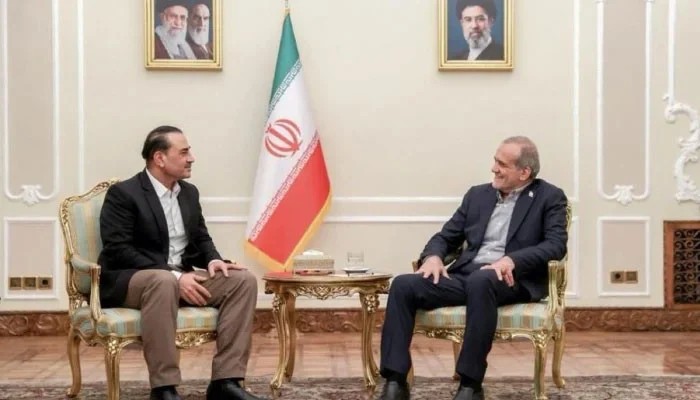
ISLAMABAD/WASHINGTON: Chief of Army Staff (COAS) and Chief of Defence Forces (CDF) Field Marshal Syed Asim Munir, along with Minister for Interior Mohsin Naqvi, concluded a day-long visit to the Islamic Republic of Iran, as part of Pakistan's diplomatic efforts to end the stalemate in the ongoing US-Iran conflict and explore ways for achieving enduring peace and permanent end to instability in the region, the Inter-Services Public Relations (ISPR) said in a statement on Monday. The Field Marshal called on Iran's President Dr Masoud Pezeshkian, Supreme Leader's Representative on Supreme National Security Council Mohsen Rezaei, Parliament Speaker Bagher Ghalibaf, Foreign Minister Seyed Abbas Araghchi, and Minister of Interior Eskandar Momeni, the ISPR said.
"Comprehensive discussions focused on measures to prevent further escalation, reopening of the Strait of Hormuz and expedited termination of the conflict. The two sides also exchanged views on regional peace and the ways to arrive at a negotiated settlement to the disputes," it added. It further stated, "The Iranian leadership appreciated Pakistan's constructive role and sincere efforts towards facilitating dialogue, de-escalation and a peaceful resolution of the conflict." Upon arrival, the Field Marshal was received by Eskandar Momeni, Minister of Interior of Iran, and other senior Iranian civil and military officials.
Meanwhile, US President Donald Trump spoke with Pakistan's army chief Asim Munir last week ahead of CDF Munir's trip to Tehran on Monday, three Pakistani sources told. The White House Office of the Press Secretary did not immediately respond to a request for comment. It was unclear what Field Marshal Asim Munir and Trump discussed in detail. The CDF arrived in Tehran on Monday accompanied by Interior Minister Mohsin Naqvi, saying it was "part of Pakistan's efforts to promote regional peace and stability." Meanwhile, Ghalibaf said in a statement carried by state television that Iran was "working to implement the terms of the Islamabad memorandum of understanding" that Tehran and Washington signed in June towards ending the war.
Meanwhile, US Treasury Secretary Scott Bessent on Monday laid out plans for the "economic asphyxiation" of Iran, expanding Washington's secondary sanctions threats and warning of dire consequences for countries that do not join the campaign. The announcement comes almost six months into a war on Iran that has ground to a stalemate, with stalled peace talks and Tehran blocking most traffic through the crucial Strait of Hormuz. Bessent earlier said the United States was declaring an "economic D-Day" on Iran, but his announcement named no specific countries beyond Iran and no timelines. The Treasury Department said expanded secondary sanctions would target Iran's digital assets, technology, gold, aviation and shipping sectors.