
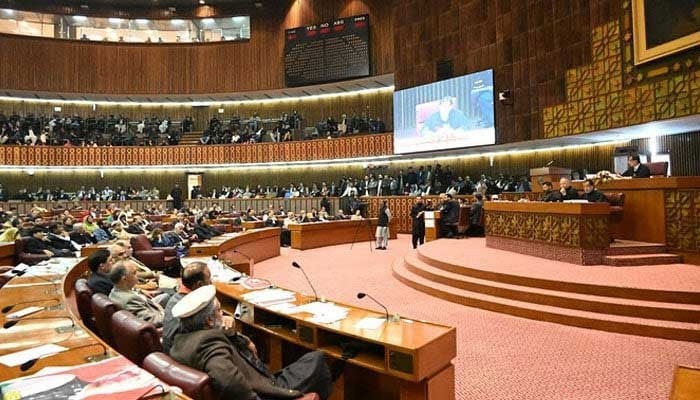
The National Assembly has 336 MNAs. The four provincial assemblies have 749 MPAs. The Senate of Pakistan has 96 senators.
That is a total of 1,181 legislators - but on structural constitutional reform, the two main leaders of Pakistan Muslim League-Nawaz (PML-N) and Pakistan Peoples Party (PPP) exercise an effective veto over the entire system. Begin with Article 239. A constitutional amendment requires the support of not less than two-thirds of the total membership of both houses of parliament.
In the 336-member NA, that means 224 votes. In the 96-member Senate, it means 64 votes. In the 16th NA elected in February 2024, the Pakistan Muslim League-Nawaz (PML-N) has 133 seats.
Take those 133 votes away and only 203 MNAs remain. Even if every single one of them supported an amendment, they could not reach 224. That means: Under the present arithmetic, the Pakistan Muslim League-Nawaz (PML-N) can block any constitutional amendment in the NA.
Question: How does the Pakistan Muslim League-Nawaz (PML-N)'s blocking position translate into a veto power for its party leader? Answer: Under Article 63A, the Pakistan Muslim League-Nawaz (PML-N)'s party-head can issue binding directions to the party's 133 members - and a member who votes or abstains contrary to that direction faces defection proceedings. Call it what it is: on paper, 224 MNAs decide.
In practice, large party blocs decide together - and party leadership controls those blocs. The Provincial Assembly of Sindh has 168 seats; two-thirds means 112 votes. The Pakistan Peoples Party (PPP) has 117 members.
Yes, constitutionally, the Pakistan Peoples Party (PPP) president personally has no veto. Nor does the Pakistan Muslim League-Nawaz (PML-N) supremo. Yes, the constitution gives powers to parliament, provincial assemblies and parliamentary parties.
Pakistan has 1,181 legislators. Yet on structural reform, the effective decision can come down to two political power centres. Is this parliamentary sovereignty?
The constitution requires a supermajority to change the system. But Article 63A means that hundreds of legislators do not necessarily vote as hundreds of independent representatives. They vote in party blocs.
And here lies the irony. Those who benefit most from the present structure can also block changes to that structure.Lo and behold, the system has given the status quo its own veto. Yes, the constitution requires a supermajority to change the system.
But - Article 63A has converted that supermajority of legislators into the permission of a few party leaders. Lo and behold, the beneficiaries of the existing system have acquired the power to veto reform of the existing system. The writer is an Islamabad-based columnist.