
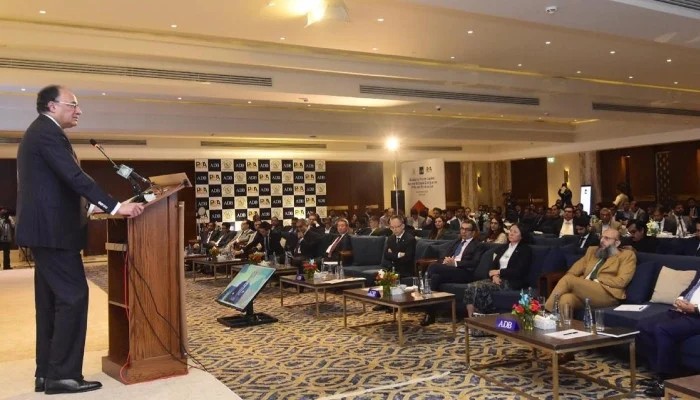
Owing to the continuing regional conflict, which remained a major external uncertainty, Finance Minister Muhammad Aurangzeb said the government, in consultation with the State Bank of Pakistan, was closely monitoring its possible effects on inflation and economic growth. The government was targeting economic growth of more than 4pc for the ongoing fiscal year.
Total foreign exchange reserves, which stood at $18.4 billion on June 30, were expected to reach $21 billion by the end of the fiscal year, providing a little more than three months of import cover, Minister for Finance Muhammad Aurangzeb stated on Friday. Addressing the Mobilising Private Capital: National Strategic Dialogue on PPPs and Privatisation, organised by the Asian Development Bank, the finance minister said Pakistan was working on a rupee-denominated, dollar-settled bond and planned to raise foreign exchange reserves to $21 billion in the current fiscal year.
The government was also exploring the tokenisation of some of Pakistan's existing Eurobond debt, drawing on the model adopted by Hong Kong, Aurangzeb said. He noted that Pakistan had received three sovereign credit-rating upgrades since April 2025, enabling it to return to international capital markets after an absence of about 4 years.
Outlining the government's broader economic priorities, the finance minister said Pakistan must preserve macroeconomic stability, move towards sustainable growth, and enable the private sector to lead future economic expansion. Aurangzeb added that Pakistan had made considerable progress in addressing the country's structural twin-deficit problem over the past 2.5 to 3 years.