
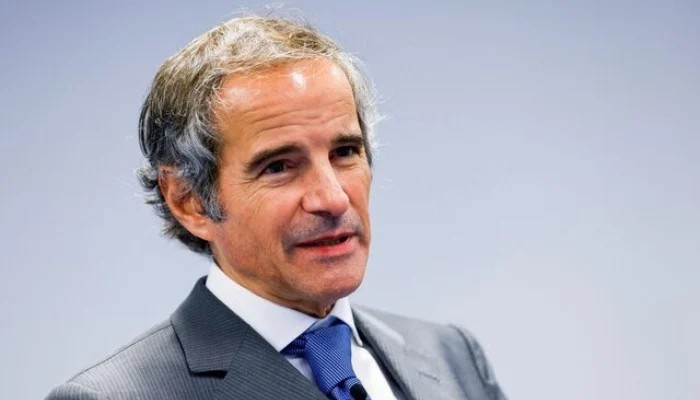
ISLAMABAD/ RIYADH/DUBAI: In an important development, for the first time, the International Atomic Energy Agency (IAEA) has reached out to Pakistan and assured "technical support" in the implementation of the Islamabad Memorandum of Understanding (MoU). The MoU was signed in June 2026 as an interim agreement to end hostilities between Iran and the United States. Late Monday night, Ambassador Rafael Grossi, Director General of the IAEA and candidate for UN Secretary-General, telephoned Deputy Prime Minister/ Foreign Minister Ishaq Dar and, while discussing the evolving regional situation, agreed that implementation of the Islamabad MoU remained the best course of action to defuse tensions, with Ambassador Grossi offering technical support should the need arise, said the Foreign Office.
But there were no details by the Foreign Office as what this "technical support " entailed, though it could be related to disposal of nuclear matter because in the past the IAEA and Iran have differed on nuclear material safeguards, waste monitoring and regulatory compliance. As the race for the selection of the office for the new secretary general of the UN in 2027 draws close, Grossi also used the opportunity to campaign for his candidacy for the office of the UNSG, with Dar wishing him well.
So far eight active candidates have emerged officially, while canvassing for the office, with Rafael Mariano Grossi and former leader such as Macky Sall ahead in the race. Dar reaffirmed to Grossi Pakistan's enduring commitment to advancing the purposes and principles of the UN Charter and to respecting international law and treaties. "The DPM/ FM also highlighted the crucial importance of the UN system in realising the global peace and development agenda.
He wished Ambassador Grossi well in his campaign for the office of UNSG," said the FO. Meanwhile, the foreign minister chaired a meeting to review the programme for the 81st Session of the United Nations General Assembly. The foreign secretary and special secretary (UN) briefed the DPM/ FM on the proposed programme, including high-level engagements, bilateral meetings and other key engagements on the sidelines of UNGA.
Dar reviewed the proposed programme, provided guidance on its priorities and arrangements, and directed that close coordination and readiness be ensured for Pakistan's active engagement during the high-level session. Earlier the Foreign Office had confirmed Pakistan's delegation to the UNGA which is being led by Prime Minister Shehbaz Sharif, with the FO actively finalising diplomatic protocols, core priorities and readiness strategies ahead of the session.
The FO announced that a structured programme is being planned for the DPM/FM Dar to actively participate in the 81st Session of the UNGA. Meanwhile, US Chargé d'Affaires Natalie A Baker called on DPM/ FM Dar. Discussions focused on Pakistan-US bilateral cooperation and recent regional developments.
Dar underscored the importance of dialogue and diplomacy for lasting peace. The DPM/FM appreciated the positive trajectory in Pakistan-US relations and stressed the need for regular engagement on issues of mutual interest. Referring to the upcoming 81st UNGA Session in New York, he noted that Pakistan's delegation would be led by the prime minister.
Meanwhile, Saudi Arabia issued security alerts over a range of territory on Tuesday, including in the holy city of Makkah and second-largest city Jeddah, following a week of attacks from Iran-aligned fighters that have drawn it deeper into the Middle East war. The alerts were swiftly lifted and Saudi authorities did not immediately report whether any incoming projectiles had landed, nor was there any immediate claim of responsibility for attacks.
But the alerts were the widest ranging since an escalation in the conflict last week, and the alarm in Makkah was the first of the war in the city. Saudi Arabia vowed to respond "firmly" to attacks by Houthis, after the Iran-backed fighters wounded 13 people in the kingdom in an assault using ballistic missiles and drones. The Iran-aligned Houthis in Yemen have announced a number of major attacks on Saudi Arabia over the past week, including strikes on an air base on Monday they said were in retaliation for airstrikes on Yemen.
Saudi Arabia has blamed a separate pro-Iranian movement, based in Iraq, for an attack on Friday that knocked out one of the Kingdom's most important oil transport routes, the East-West Pipeline across the Arabian desert. Crude oil should be flowing through the pipeline within days, US Energy Secretary Chris Wright told CNBC on Tuesday. A Saudi-led military coalition fighting against the Houthis in Yemen said 13 civilians had been wounded in the Houthis' attacks on Saudi Arabia on Monday.
Officials from a Saudi-backed Yemeni government, which is based in the south of the country and opposes the Houthis, said the Saudi and Yemeni air forces had been responding to Houthi advances by stepping up aerial bombardment of Houthi targets. That included strikes near the historic Red Sea port of Mocha, which the fighters captured last week. But the Yemeni officials acknowledged that the Houthis had now taken effective control over almost the entire western coast of the country along the Red Sea.
Saudi Arabia's Crown Prince Mohammed bin Salman met Egyptian President Abdel Fattah al-Sisi in Cairo on Tuesday. A statement from the Egyptian presidency after the meeting said the leaders stressed the need to ensure freedom and security of navigation in the Bab el-Mandeb and the Red Sea. A US military task force is working to enhance intelligence sharing and planning assistance for Saudi forces, a US official said Tuesday, as the kingdom faces attacks from Houthi fighters.