
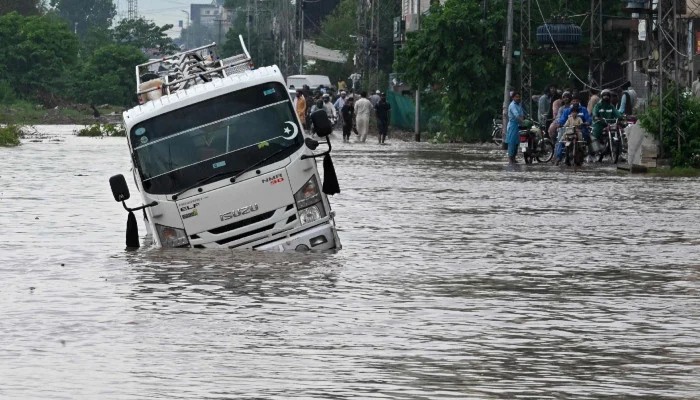
Ten feet: that is how high the water rose in Rawalpindi's Leh Nullah before dawn broke over the capital two weeks back, turning Murree Road and Bhara Kahu into rivers and trapping commuters where they stood. No cyclone made landfall. No unprecedented deluge was recorded. This was an ordinary monsoon downpour, and it was enough, once again, to bring Pakistan's capital region to its knees. Before anyone reaches for the phrase 'natural disaster', it is worth being precise about what actually happened. The rainfall itself was a natural hazard; the scale of disruption that followed was shaped by how the city has been planned, built and managed.
This was an entirely foreseeable monsoon spell meeting a drainage system, a set of encroached waterways and a planning culture that had four prior summers to prepare and chose, in each of them, to be surprised instead. Calling that nature's fault is not humility. There is also a physical reason 'ordinary' spells now behave like extraordinary ones. A warmer atmosphere can hold roughly seven per cent more water vapour for every degree Celsius of warming, and that extra moisture does not fall gently; it is released in short, violent cloudbursts rather than the steadier rain older drainage systems were built to handle. Islamabad's infrastructure is not just poorly enforced. It is calibrated to a climate that no longer exists.
That does not excuse four summers of institutional shrugging. It does mean the goalposts have moved, and pretending otherwise is its own kind of denial. That distinction changes where the accountability sits. Islamabad does not flood because the sky has singled it out. It floods because the city has built, permit by permit, on the assumption that this year's rain would behave better than last year's. Streams that once carried water out of the capital have been narrowed, built over or turned into dumping grounds by developers whose projects encroached on natural drainage channels, while enforcement repeatedly failed to prevent it.
Research on the Lower Indus below Kotri Barrage has found that sediment deposition there has reduced the flood-carrying capacity of that river reach by close to 18 per cent: a striking illustration of how sediment accumulation and upstream human intervention can silently erode a river system's ability to handle floods. Islamabad's own seasonal streams face a different but related set of pressures: encroachment, narrowing, and drainage never designed for today's rainfall intensity.
Forests on the Murree hills have been stripped of the root systems that once held slopes together - witness the building that came down on the Murree Expressway last month, taken out not by fate but by a landslide, already weakened by deforestation. This is engineering handed over to politics, and politics losing, on schedule, every single year. Here is the harder truth Islamabad's planners would rather not sit with: this is the one Pakistani city with no excuse of poverty or capacity to hide behind. Karachi can point to a broken tax base and a fractured municipal structure split across a dozen competing authorities. Islamabad has the Capital Development Authority (CDA), the best-funded, most heavily regulated urban authority in the country, and that authority still cannot keep a single suburb dry through one monsoon spell. What does it say about a state's priorities when its own capital cannot manage the one recurring disaster it has had eight decades and every available resource to fix?