
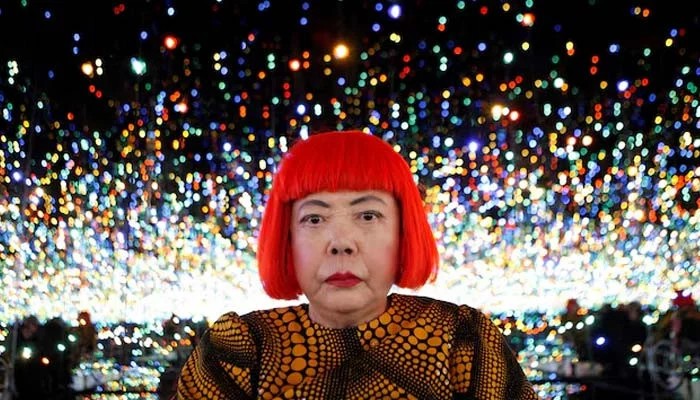
Yayoi Kusama, the acclaimed Japanese avant-garde artist who transformed her hallucinations into works that ranged from vibrant dot-covered paintings and pumpkin sculptures to infinity mirror room installations, has died at the age of 97. Diminutive and known for sporting a scarlet bob wig later in life, Kusama was candid about her mental health struggles, saying she experienced visions and hallucinations of flashing lights, dots and flowers since childhood.
"I still see hallucinations even now," she told reporters in 2017. "Dots come flying everywhere - on my dress, the floor, things I'm carrying, throughout the house, the ceiling. And I paint them." Kusama died in hospital on 14 August, according to a statement by the Yayoi Kusama Museum, adding that she continued to paint until her final days. No cause of death was given.
Born on 22 March 1929, in Matsumoto City, central Japan, Kusama had a troubled childhood marked by family conflict. She said she was overwhelmed by fear and that it reached the point where she wanted to die every day. "What kept me from ending my life was drawing and making art. That has never changed. It was through discovering my love of art that I have been able to survive and continue living to this day," she said in a 2014 interview with Vogue Japan.
During her school years, she was mentored by the Japanese painter Kakei Hibino and later went to the Kyoto Municipal School of Arts and Crafts to study traditional Japanese painting. Frustrated with the confining nature of Japanese society, Kusama left for New York in 1957. There, she quickly made a name for herself, exhibiting net paintings, soft sculptures, creating body painting events and happenings to protest the Vietnam War as well as writing fiction and poetry.
She is often said to have influenced Andy Warhol. But her mental health declined and she returned to Japan in 1973, voluntarily entering a psychiatric hospital four years later where she continued to live, being driven to her nearby studio each morning. As her fame grew, her international exhibitions attracted huge crowds and her works commanded lofty prices. One painting, Untitled (Nets) (1959), sold for $10.5 million in 2022.