
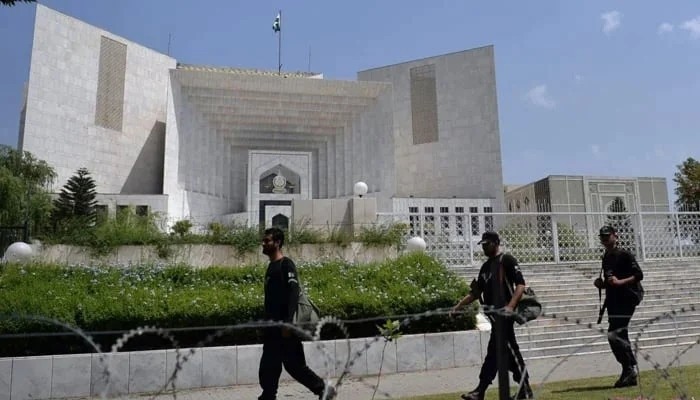
The Federal Constitutional Court (FCC) has recommended that the legislature may consider prescribing a maximum age in the range of sixty-five to seventy years for persons seeking election to the office of the executive of the trade union. A two-member bench of the Federal Constitutional Court comprising Justice Syed Hasan Azhar Rizvi and Justice Muhammad Karim Khan Agha announced on Friday, a judgment in a civil petition titled Muhammad Akhlaq Khan verses National Industrial Relation Commission (NIRC) and others.
The petitioner, Muhammad Akhlaq Khan, had filed a civil petition challenging the Sindh High Court's judgment dated 29.08.2023 concerning the petitioner's eligibility to contest the KESC Labour Union elections. He was an employee of the Karachi Electric Supply Company (KESC), now K-Electric, and a member of the union. He was elected chairman of the union in 2017 and again in 2019.
While a single member of the NIRC found no evidence of ineligibility, the NIRC full bench reversed that decision. The high court upheld the full bench's order, holding that the petitioner was ineligible under the proviso to section 8(1)(d) of the Industrial Relations Act, 2012. The Federal Constitutional Court after hearing the matter in length allowed the appeal and set aside the impugned judgment of the Sindh High Court.
The 35-page judgment, authored by Justice Muhammad Karim Khan Agha set aside the SHC impugned judgment after allowing petition filed by the petitioner in the terms that the remaining twenty-five percent of the members of the executive of a trade union contemplated by the proviso to section 8(1)(d) of the IRA 2012 are not necessarily required to be workmen and may include persons who are not workmen.
"We hold and declare that the remaining twenty-five percent of the members of the executive contemplated by the proviso to section 8(1)(d) of the IRA 2012 need not be workmen and may include persons who are not workmen", the court held. The court, however, ruled that the provision does no more than permit such persons to become part of the executive; their eligibility to hold office remains subject to the constitution of the trade union and any other applicable provision of law.
"The individual eligibility of the petitioner to contest the election against the remaining twenty-five percent of the executive of the Union shall be determined accordingly," says the judgment. The court noted that a question was also raised regarding the maximum age of a person seeking election to the office of the executive of the trade union within the aforesaid twenty-five percent percentage. The court, however, noted that no such age restriction has been prescribed by the IRA 2012.
"In view of the principle of separation of powers, we do not consider it appropriate for this court to prescribe any such age limit, that being a matter for the legislature," says the judgment. "We would, however, recommend that the legislature may consider prescribing a maximum age in the range of sixty-five to seventy years for such persons, together with an appropriate requirement as to their physical and mental fitness," the judgment added.
According to the judgment, Salahuddin Ahmed, counsel for the petitioner argued that the High Court misinterpreted section 8(1)(d) of the IRA 2012, as the proviso exempts the remaining 25 percent of union executives from the requirement of being workmen of the relevant establishment or industry. Similarly, the judgment noted that Muhammad Umer Lakhani, counsel for the respondents, opposed the petition, arguing that the petitioner had accepted the earlier NIRC order finding him ineligible and participated in the election process without directly challenging that order.