
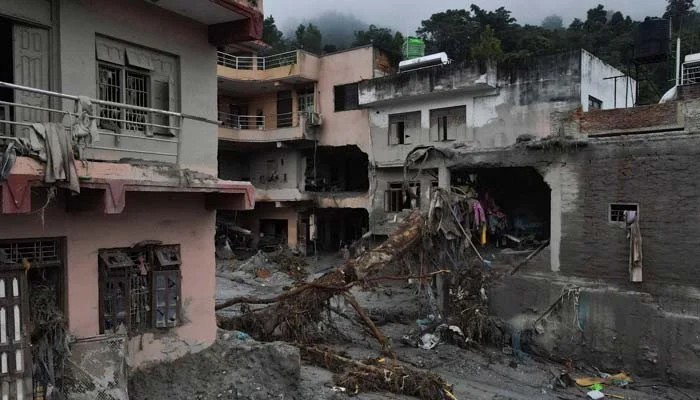
KATHMANDU/BEIJING: Nepal's rescue teams, helped by Chinese and Indian experts, worked overnight to reach hundreds of people believed to be stuck inside blocked hydropower project tunnels in the aftermath of last week's Himalayan flood that carved a trail of destruction in the country's valley towns and villages as well as across the border in China. The unprecedented deluge of ice, rock, mud and debris on the Nepal-Tibet border on Wednesday - blamed on a glacier collapse - killed more than 900 people and nearly 5,000 are still missing. Hundreds of bodies, many unidentified, have been buried in shallow graves as they began decomposing in the humid weather in the plains of the Himalayan country after being swept down the mountains by the torrent. Nepali officials said that the focus was on reaching the hundreds of workers believed to be trapped inside about half a dozen hydropower project tunnels that had been blocked by mud and rock debris.
Pictures and videos shared by rescue teams showed earth-moving equipment digging and shovelling mud and rocks under lights in the dark of the night as workers watched. Soldiers used torchlight in a big pit they had created to look for space to get into one tunnel. Nepal's disaster management authority said that 933 people were missing from hydropower projects in the flood-hit region. The Red Cross has estimated that more than 90,000 people are likely to have been affected by the disaster, which China has linked to the effects of climate change. On Monday, Nepali authorities said 903 people had died, with 4,247 missing, including the 933 at hydropower projects. On the Chinese side, authorities said 16 people were killed in Gyirong County and 546 were missing.
"A large amount of debris has been deposited and that is posing us a big challenge to open the tunnels," Nepal army spokesperson Raja Ram Basnet told reporters. "Our main focus is on opening the tunnels." Prime Minister Balendra Shah said the flood was an "unprecedented and devastating natural disaster" and it remained challenging to compile a complete assessment of the damage. "Despite the adverse weather, difficult terrain and continuing risks, we are moving forward with determination to save the lives of our citizens," he said in a Facebook post late on Sunday, adding that nearly 21,000 security personnel were involved in the rescue operations, besides civilian workers and volunteers.
Chinese President Xi Jinping, on a visit to Kyrgyzstan, said Beijing is making every effort to search for missing people following the disaster, Xinhua reported on Monday. Beijing has said 261 foreign nationals from 23 countries were unaccounted for in Tibet, near a key border crossing with Nepal. China's state-run CCTV reported Beijing has mobilised more than 2,100 rescue workers and allocated at least 220 million yuan ($33 million) to support relief efforts and has been airdropping equipment and supplies to frontline rescuers, while its soldiers used life-detection equipment to look for the missing. Although Nepal has said that it does not need foreign help in general rescue and search, it has leaned on giant neighbours India and China for their expertise in tunnel rescue. Rescue operations have been suspended several times since Friday because of bad weather and concerns that a lake formed across the Nepal-China border by the disaster could trigger fresh flooding after it began overflowing into Nepal's rivers. China's state television CCTV said that another lake has formed in the upper regions.