
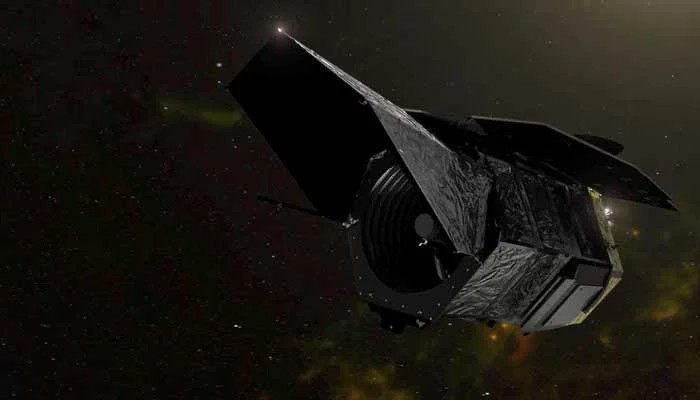
Nasa is preparing to launch its next flagship space observatory, one that scientists plan to use to investigate some of the universe's biggest mysteries, including dark energy and dark matter, while also testing gravity at vast scales and hunting for planets beyond our solar system. The launch of the Nancy Grace Roman Space Telescope, a roughly $4 billion project, is planned for Sunday at Nasa's Kennedy Space Center in Florida, with the observatory to be lofted into orbit aboard a SpaceX Falcon Heavy rocket. The launch comes nine months ahead of schedule, according to US space agency officials.
Roman is a follow-on to the Hubble Space Telescope, launched in 1990, and the James Webb Space Telescope, launched in 2021, and has capabilities that can expand on the knowledge gained by those pioneering observatories, both of which continue to operate. The new telescope's panoramic view of space and its rapid survey speeds offer the opportunity for scientists to study the cosmos as never before, with wide-field surveys examining its structure, composition and evolution.
"Roman's vast reach will allow us to find the weird, the rare and the unusual," Julie McEnery, Roman's senior project scientist at Nasa's Goddard Space Flight Centre in Maryland, told reporters. "Roman's primary instrument combines exquisite performance and sensitivity with the ability to quickly and efficiently survey the large regions of the sky," McEnery said, adding that the main survey will contain over two billion galaxies.
Physicist Albert Einstein in 1915 presented his theory of general relativity, explaining gravity, and it remains foundational. Roman will map how galaxies cluster and how matter bends light through a phenomenon called gravitational lensing, helping scientists test whether Einstein's theory holds true on massive cosmic scales.