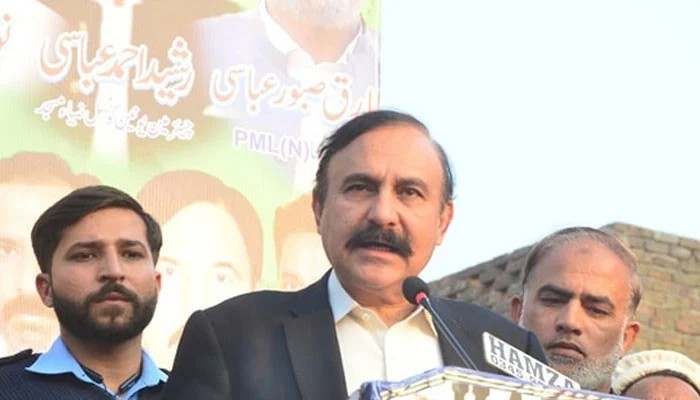
Federal Minister for Parliamentary Affairs Dr Tariq Fazal Chaudhry on Tuesday ruled out any proposal to shut down Islamabad or impose a smart lockdown, saying no such suggestion was discussed at a meeting chaired by Deputy Prime Minister Ishaq Dar. Talking to the media, the minister said the meeting did not discuss any proposal for a smart lockdown and that no such proposal was in his knowledge.
He said the meeting mainly focused on petroleum product prices and measures aimed at providing relief to the people, adding that targeted subsidies were being provided for three months to two-wheelers and vehicles with engine capacity of up to 800cc. Chaudhry said public representatives were being assigned the responsibility of creating awareness among citizens about the facility. Clarifying the situation in the federal capital, the minister said Islamabad was not going to be shut down mentioning that there was talk of three marches to be held in the federal capital during this month.
Commenting on the Pakistan Tehreek-e-Insaf's (Pakistan Tehreek-e-Insaf (PTI)'s) protest strategy, Chaudhry said the Pakistan Tehreek-e-Insaf (PTI)'s marches had been the most violent and disorderly. Referring to a recent Islamabad High Court decision, the minister said the administration had been directed to ensure that citizens' movement remained uninterrupted and that leaders of any political party were not allowed to occupy public places. He said the administration was fulfilling its responsibility, adding that those who repeatedly marched towards Islamabad while describing their demonstrations as peaceful and then resorting to violence should reconsider their approach.
"If anyone thinks that they are coming to change the system, the system will not change merely by coming to Islamabad," he said. The parliamentary affairs minister said Prime Minister Shehbaz Sharif had repeatedly invited the opposition to hold negotiations. "Going to the prime minister's doorstep and merely demanding his resignation will not make him resign," he added.
Meanwhile, addressing a press conference on the PM's fuel relief scheme, Federal Minister for Climate Change and Environmental Coordination Dr Musadik Malik said that the premier was fully aware of the difficulties being faced by the people and decided that the government would absorb the impact of the rising petroleum prices rather than passing the entire burden on to the poor. He said the government was providing a relief of Rs100 per litre on petrol to eligible consumers, while the petroleum levy was Rs80 per litre and the carbon tax amounted to Rs5 per litre.
"There should be no ambiguity that the relief being provided to the poor is greater than the levy and taxes being collected on petrol," he said. Dr Malik said the objective of the scheme was to provide direct relief to low-income people so that they could meet their daily needs. Under the scheme, motorcycle users would receive relief on five litres of petrol every week, while users of vehicles up to 800cc would get relief on 10 litres every 10 days, he added.
The minister said the relief package did not mean that petrol prices had become low, adding the government itself considered the relief insufficient given the high cost of fuel. "Whatever relief could be provided, and whatever is the right of the poor people, the prime minister decided that it should be delivered to them," he said. Dr Malik said the government had wished to reduce petrol prices for everyone, but the prime minister had directed that the poor should be given priority.
Giving examples of beneficiaries, he said women were also driving Qingqis and earning a livelihood with dignity. He referred to a woman namely Zainab supporting a family of five and have two children. "Under the scheme, she would receive Rs2,000 relief on 20 litres of petrol, which could help her pay her child's school fee." Similarly, he added, a man used an 800cc car to travel to his factory, while his wife used the same vehicle to take their children to school.
The family would receive Rs3,000 relief on 30 litres of petrol. The minister said the international increase in petroleum prices had been caused by the US-Iran war and its repercussions, adding that the political and military leadership was making efforts to promote peace in the region. He said Pakistan's efforts for regional peace were being recognised internationally.
"There was a time when terrorism was mentioned, Pakistan was mentioned. Today, when peace is discussed, Pakistan is being described as a guarantor of peace," he said. Dr Malik said the government was trying to ensure that the flames of war were brought under control, which would provide relief not only to Pakistan but also to poor people across the world.
He said the PM's fuel relief scheme had already been launched in Islamabad and would be extended to the four provinces, as well as Azad Jammu and Kashmir and Gilgit-Baltistan within the next few days. He said beneficiaries would first have to register for the scheme, while details of the registration process were being disseminated through television advertisements and the scheme's website. "Stalls would also be established at different locations from Wednesday (today) to facilitate registration and guide people about the process," he said.
The minister said the prime minister believed that a dignified life meant enabling families to live with respect, send their children to school, provide medicines and healthcare to elderly parents and ensure quality education and health facilities for their children. He said whenever an external shock hit the country, the government had two options: either pass its impact on to the people or absorb it itself.