
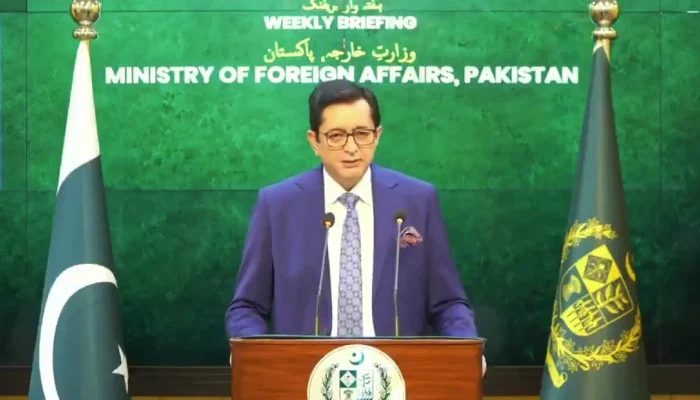
Pakistan on Friday reiterated its commitment to safeguarding Saudi Arabia's sovereignty, territorial integrity, and security, while dismissing reports that Pakistani fighter jets had taken part in cross-border operations targeting Houthi forces in Yemen. During a weekly press briefing, Foreign Office Spokesperson Ambassador Sajjad Haider Khan said that the Makkah alliance is a defensive arrangement aimed at protecting the sovereignty and territorial integrity of its member countries and strengthening their collective deterrence capabilities.
Referring to the emergency meeting of the Strategic Political and Defence Committee of the Makkah Joint Defence Agreement held in Riyadh on October 5, he said Pakistan, Saudi Arabia, and Turkiye had agreed to move towards the practical implementation of their collective defence commitments.
Deputy Prime Minister and Foreign Minister Senator Mohammad Ishaq Dar, Defence Minister Khawaja Muhammad Asif, and Chief of Army Staff General Syed Asim Munir represented Pakistan in the meeting, he added. The spokesperson said the committee reviewed the security situation and threats facing Saudi Arabia and condemned attempts to target Makkah and Madinah, as well as attacks on cities, civilians, and economic infrastructure.
Khan said the three countries had approved measures to enhance readiness, military integration, and their collective capacity to address security threats. Clarifying the nature of the alliance, he said it was intended to defend member countries against aggression and that Pakistani forces would not cross into Yemen to launch attacks against Houthi forces.
However, he said they could be utilized to defend Saudi territory and safeguard its sovereignty. He said Pakistan had a substantial number of forces and resources in Saudi Arabia, adding that the alliance would assess threat perceptions and determine operational requirements in accordance with its mandate.
The spokesperson also rejected speculation about Pakistani fighter jets taking part in airstrikes against the Houthis, describing such reports as false. Responding to questions about Pakistan's military presence in Saudi Arabia, the spokesperson said Pakistani armed forces had been present in the Kingdom in various capacities since 1982, including under logistical arrangements and training missions.
He said further deployments would be determined according to operational requirements and decisions by the alliance's headquarters. He said Pakistan remained concerned about the escalation in the region, particularly because approximately 2.5 million Pakistanis resided in Saudi Arabia.
He noted that the security situation could put Pakistani nationals at risk and reiterated Islamabad's commitment to supporting their welfare. Pakistan had consistently advocated de-escalation, dialogue, and diplomacy, he said, adding that the country remained committed to protecting Saudi Arabia's sovereignty.
On Pakistan's diplomatic engagement in the region, Khan said Islamabad continued to support political dialogue and efforts to reduce tensions between the United States and Iran. He said direct communication between the two countries, including discussions on seven points, reflected the progress made through Pakistan's mediation efforts.
The spokesperson said the Islamabad Memorandum of Understanding (MoU) remained in place and that Pakistan was willing to continue facilitating a negotiated solution if required.