
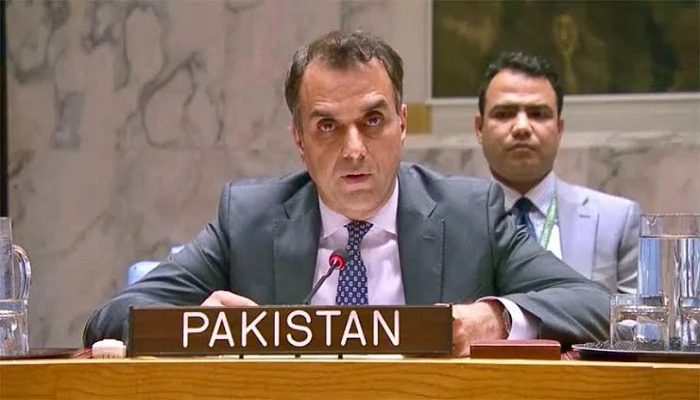
Pakistan rejected India's unilateral move to place the Indus Waters Treaty in abeyance during a United Nations Security Council meeting in New York on Wednesday. Pakistan warned that India is threatening the livelihoods of more than 240 million people.
- Pakistan rejected India's unilateral decision to place the Indus Waters Treaty in abeyance during a United Nations Security Council meeting in New York.
- Ambassador Usman Jadoon stated that the Permanent Court of Arbitration confirmed the treaty remains fully in force with no provision for unilateral suspension.
- Pakistan urged the international community to take notice of hydro-aggression in the region and called for peaceful dispute-settlement mechanisms under Article 33 of the UN Charter.
United Nations Security Council
Ambassador Usman Jadoon stated that the Permanent Court of Arbitration confirmed the treaty remains fully in force. The Indus Waters Treaty contains no provision allowing either country to suspend the agreement unilaterally.
Speaking at an Arria-formula meeting on natural resources and conflict, Pakistan's Deputy Permanent Representative Ambassador Usman Jadoon stated that India sought to weaponize water against Pakistan by unilaterally placing the treaty in abeyance and threatening to stop water flows. Jadoon warned that such actions endangered the livelihoods and well-being of more than 240 million people and risked escalating tensions between the two neighboring countries.
India-Pakistan Relations
The envoy noted that the Permanent Court of Arbitration reaffirmed in its award of August 31, 2026, that the treaty remained fully in force and that India continued to be bound by its obligations. He emphasized that no country should be allowed to use shared natural resources as instruments of coercion or political pressure in violation of international law and binding treaty obligations.
The remarks followed a dispute over India's April 2025 decision to place the 1960 Indus Waters Treaty in abeyance following the killing of 26 people in Indian Illegally Occupied Jammu and Kashmir. New Delhi accused Islamabad of involvement in the attack, a charge that Pakistan denied.
Indus Waters Treaty
The treaty, brokered by the World Bank, allocates the eastern rivers: Ravi, Beas, and Sutlej to India and the western rivers: Indus, Jhelum, and Chenab largely to Pakistan. Referring to UN Security Council Resolution 2788, Jadoon called for the use of peaceful dispute-settlement mechanisms under Article 33 of the UN Charter.
Pakistan reaffirmed its commitment to peaceful coexistence while urging the international community to take notice of hydro-aggression in the region.