
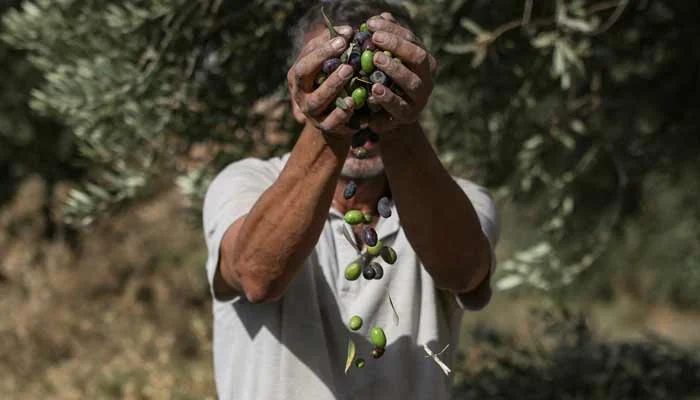
"They don't want us to plant, to farm anything," says Palestinian farmer Abdellatif Bazzari, looking out at his rows of olive trees that are half harvested before the season has even started. Bazzari, who was injured in a raid on the fields by Israeli settlers that killed his cousin, is afraid to return to harvest the other half without some sort of army protection, fearing a new attack.
Like many olive farmers in the plains nestled between the occupied West Bank's sinuous limestone hills, Bazzari decided to harvest as early as possible this year, hoping both to save his crops and avoid beatings. With Israel heading to elections on October 27, some farmers believe the violence will escalate as Prime Minister Benjamin Netanyahu, locked in a tight race, seeks to shore up his right-wing base.
"I think the prime minister of Israel is worried about the results of elections and he doesn't want to take any action against the settlers as he hopes to receive their votes," Bazzari told AFP. "If he loses, things will get better," he hoped.
Olives are as important economically to Palestinians as they are a symbol of their attachment to the land, accounting for an estimated 15% of the West Bank's agricultural GDP. On October 7, a group of about 15 to 20 settlers raided the field where Bazzari and his family were picking olives by hand, beating them, before the army intervened and shot dead Bazzari's cousin Ali Bazzari, he said.
"My cousin bled to death right under this olive tree, irrigating the soil of Palestine with his blood," Bazzari said, pointing to a tree in the field. Bazzari said the Israeli army, which had been dispatched to the site of the raid, an isolated field near the West Bank village of Burqa, kept the ambulance from reaching his cousin after he was shot.
The Israeli military said troops and border police forces were dispatched after reports of "rock hurling toward an Israeli civilian, who was injured", referring to a settler. During the confrontation between dozens of Palestinians and Israeli settlers, "a commander operating in the area identified a terrorist running toward him while carrying a suspicious object and neutralised him", it added.
Israeli leaders also highlight violence against Israelis, including the shooting death of a settler by a Palestinian last month. Bazzari, like other West Bank Palestinians, feels the squeeze.
"They don't want us to plant, to farm anything. They said, just stay in your village, cities, and don't go out," he said.
The olive harvest season, which lasts over a month, is a time for Palestinians to gather in fields, with family, friends, and workers helping out for a process mostly done by hand. Bazzari said settlers had stolen agricultural tools during their raid on his land, including ladders used to reach tree tops, rakes used to pick a whole branch's worth of olives at once, and tarps used to catch and gather the fallen olives.
More than 500,000 Israeli settlers live in the West Bank, which Israel has occupied since 1967, in settlements and outposts illegal under international law. Netanyahu, who governs with the far-right, has ramped up approval of settlements.
Settler attacks against Palestinians, including beatings, vandalism, and arson, averaged six a day in the first half of the year, according to the United Nations.