
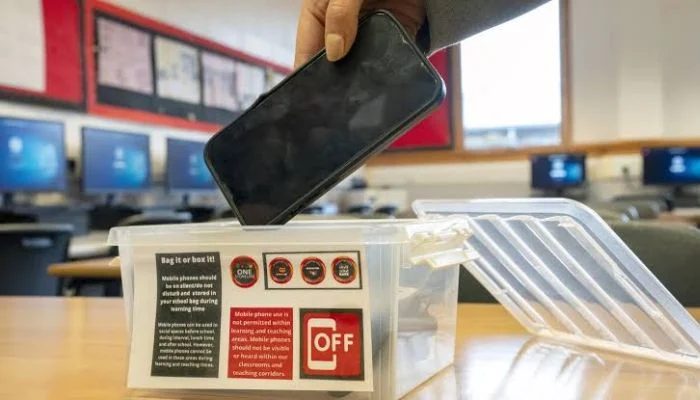
Pupils in England will no longer be allowed to keep mobile phones in their bags or pockets during the school day under strengthened government guidance aimed at creating "truly phone-free" schools. Statutory guidance came into force in June, making schools and trusts legally responsible for being phone-free throughout the day.
But ministers now say updated guidance, due to take effect from September 2027, will go beyond current "no see, no hear" policies, where phones can remain in pupils' bags if they are not seen or heard. Education Secretary Lucy Powell said the government's "clear message" to parents and pupils was that "school is for learning and friendship, not scrolling."
She added: "Children shouldn't be using smartphones at any point during the school day, full stop." The decision to implement and enforce the measures will rest with the schools. Some have installed sealed pouches or lockers, while others have opted to confiscate phones upon arrival or even ban them completely.
The head teacher of Burnage Academy for Boys in Manchester, Karl Harrison, claimed that his school had spent 20,000 pounds on metal detectors and phone pouches, which made social interaction better and concentration in classes increase. The leaders of head teachers' unions claimed that more money was needed if schools were expected to implement the changes.
Paul Whiteman, the general secretary of the National Association of Head Teachers (NAHT), stated that implementing measures above the "not seen, not heard" ones "would come at a cost." Pepe Di'Iasio, the general secretary of the Association of School and College Leaders, added that it would be very significant indeed to provide lockable pouches for all pupils, and "it is not feasible unless the government puts in the funding."
The initiative was greeted by the Children's Commissioner Dame Rachel de Souza, while the Shadow Education Secretary Laura Trott claimed that Labour has finally listened. The government maintains that removing distractions is essential for academic performance.
Research suggests that excessive screen time is linked to reduced attention spans and increased anxiety among teenagers. By removing the temptation of social media notifications, officials hope to foster a more focused environment.
Critics, however, argue that parents often rely on phones to contact their children regarding travel arrangements or emergencies. The government has countered this by suggesting that parents contact the school office directly for urgent matters.
As the 2027 deadline approaches, schools are expected to review their current policies and prepare for the transition. The Department for Education has promised to provide further support and guidance to help institutions navigate the logistical challenges of storing hundreds of devices safely.