
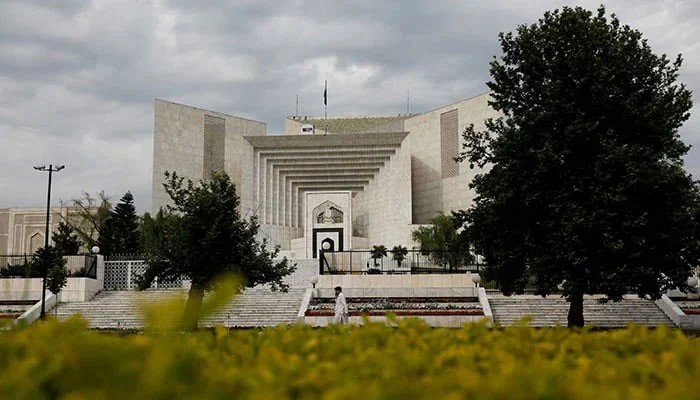
The Supreme Court on Monday ruled that mere production of postal records, without the delivery person's evidence and despite the vendee's denial, is insufficient to prove service. A three-member bench of the apex court, headed by Justice Shahid Waheed, issued the judgment in a pre-emption case titled Muhammad Niaz versus Raja Khushdil Abbasi. The other bench members were Justice Naeem Akhtar Afghan and Justice Ishtiaq Ibrahim. Petitioner Muhammad Niaz had appealed against the Peshawar High Court's December 13, 2027 judgment. The leave to appeal arose out of a suit instituted by the respondent, Raja Khushdil Abbasi, seeking possession of land through pre-emption regarding a sale made in favour of the appellant. The trial court had decreed the suit, which remained intact until the High Court's ruling.
Following detailed hearings, the Supreme Court allowed the appeal, set aside the judgments and decrees passed by the lower courts, and dismissed the respondent pre-emptor's suit. "Where service is sought to be established through postal delivery, the evidence of the person who actually delivered the notice assumes particular significance," a four-page judgment authored by Justice Shahid Waheed stated. The court noted that a person claiming pre-emption must first establish the performance of Talb-e-Muwathibat under Section 13 of the relevant Act.
In this case, the court observed that the sale in the appellant's favour was effected on October 20, 2009, through Mutation No. 7389, while the respondent claimed to have made the first Talb on January 16, 2010. "Thus, on his own showing, the respondent asserted his intention to pre-emption the sale more than eight weeks after the sale mutation was sanctioned," the judgment read. The court held that the respondent failed to prove the performance of Talb-e-Muwathibat and Talb-e-Ishhad as required by law.
Stating that these are essential conditions for exercising the statutory right of pre-emption, the court emphasized that failing to prove either is fatal to the suit. "In these circumstances, we are unable to sustain the concurrent findings recorded by the courts below," the ruling noted, adding that those findings stemmed from the misreading and non-reading of evidence alongside an erroneous application of the law. The court pointed out that the respondent's counsel relied on PW-2, Zahid Mehmood, a postman from the Katchehri Post Office. However, PW-2 merely produced the postal record and Registry No. 1190 and was not the official who allegedly delivered the notice of Talb-e-Ishhad to the appellant. His testimony could at best prove the dispatch of the notice, not its actual delivery or receipt. Given the vendee's specific denial, the court concluded that the respondent failed to establish proper service of Talb-e-Ishhad.