
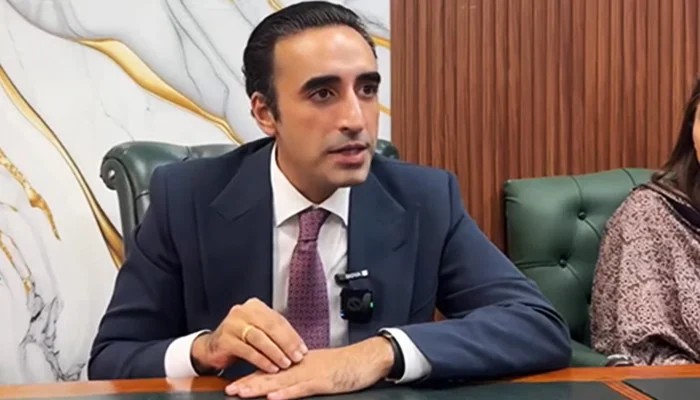
Bilawal Bhutto Zardari on Wednesday said the party would withhold its support for the Pakistan Muslim League-Nawaz (PML-N)-led government until its concerns, including over the upcoming Azad Jammu and Kashmir elections, were addressed. Speaking to journalists at Parliament House, Bilawal questioned whether such treatment was appropriate for an ally, whether in the context of the AJK elections or the political agreements the Pakistan Peoples Party (PPP) had reached with the Pakistan Muslim League-Nawaz (PML-N) before electing the prime minister.
He said the Pakistan Peoples Party (PPP) raised issues with the government in every budget for the sake of Pakistan and the provinces, asking whether the Pakistan Muslim League-Nawaz (PML-N) was addressing any of those concerns. "My party has decided that Pakistan Peoples Party (PPP)'s cooperation, coordination and legislation with the Pakistan Muslim League-Nawaz (PML-N) on general issues cannot continue until our legitimate concerns are addressed," he warned. The presser came moments after the government ally, Bilawal, met Mahmood Khan Achakzai, leader of the opposition in the National Assembly and Allama Raja Nasir Abbas, opposition leader of the Senate, at the Parliament House.
Pakistan Muslim League-Nawaz (PML-N) and Pakistan Peoples Party (PPP) have been at loggerheads ever since the start of the elections in AJK, with the latter repeatedly targeting its ally and saying that they had resorted to rigging in the polls. Bilawal also noted that Pakistan Peoples Party (PPP) members would not vote for the government's legislation if their reservations were not addressed. However, he clarified that the party could extend cooperation where a matter of national importance was involved.
Responding to a question, Bilawal said the government had not contacted the Pakistan Peoples Party (PPP) or its parliamentary committee regarding its objections, adding that political parties should sit together and resolve their differences through dialogue. He also said he was not focused on any in-house change and wanted Parliament to play its constitutional role. He clarified that he had cited the 26th and 27th constitutional amendments in his earlier comments, adding that no specific point concerning any proposed amendment had yet been placed before him.
"If a point is presented, we will discuss it in the national interest," he said. Bilawal strongly criticised the conduct of the recent AJK elections, alleging that the Pakistan Peoples Party (PPP) was defeated through rigging in several areas. He said the Pakistan Peoples Party (PPP) had raised its concerns ahead of the elections and had called for adequate security.
He referred to an attack on a candidate in Muzaffarabad and alleged that two Pakistan Peoples Party (PPP) workers were killed during the Mirpur phase of the election. Bilawal also alleged that the Pakistan Peoples Party (PPP) government in Poonch was defeated through rigging and criticised the division of the election into six phases, saying the electoral process had still not been completed. "If the Pakistan Muslim League-Nawaz (PML-N) wanted such a controversial election, then congratulations to them," Bilawal said.
He argued that a disputed government would not be able to resolve Kashmir's problems and said an administration backed by a genuine public mandate was necessary. Bilawal questioned whether such treatment could be given to coalition partners, saying Pakistan Peoples Party (PPP) members had remained part of Parliament despite being subjected to violence. He said it would be difficult for him to convince Pakistan Peoples Party (PPP) members in AJK to agree to power-sharing arrangements following what happened during the elections.
Speaking of his meeting with opposition leaders, Bilawal said he urged opposition parties to return to parliamentary standing committees, saying their active participation was essential for strengthening parliament. He further said that Pakistan Peoples Party (PPP) had always respected parliament and that he hoped opposition parties would reconsider their decision to boycott parliamentary committees. "For parliament to be functional, standing committees must be functional," he said, adding that the opposition's role in parliamentary committees was critically important.
He said Pakistan Peoples Party (PPP) had made contact with the opposition and wanted political parties to talk to each other. He called on opposition parties to play their role in electoral reforms through parliament, saying if they wanted improvement, they should come and work together on electoral reforms. On the issue of new provinces, Bilawal said the Pakistan Peoples Party (PPP) would stand with whatever decision the people reached, stressing that such decisions should be made through consensus.
"Where there is consensus, the decision should be taken through consensus. Where there is no consensus, any political party that wants to discuss the issue should come forward," he said. He said the Pakistan Peoples Party (PPP)'s position on the creation of provinces had always been clear and questioned how anyone could claim that the party opposed new provinces.
Bilawal said he had promised a province to the people of Gilgit-Baltistan and South Punjab, adding that the views of people seeking a province should be respected where there was consensus. He said he could not oppose the creation of a province if the relevant assembly did not reject the proposal. Referring to Sindh, he asked how many resolutions had been passed there regarding the creation of new provinces, saying the government should answer the question.
"I cannot even imagine conspiring against Punjab," Bilawal said, adding that he wanted decisions to be made with the people's consensus. He said the Pakistan Peoples Party (PPP) would remain on the side of the people on the issue of provinces and would support any step taken through consensus. "We did not accept coercion yesterday, and we will never accept it," he said.