
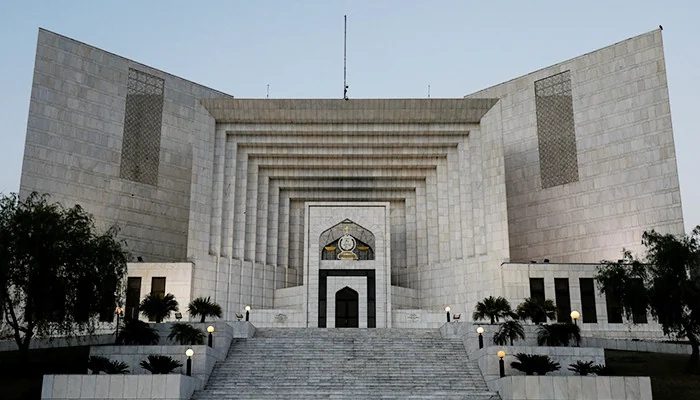
The Supreme Court on Tuesday took notice of a convict's release in a murder case after serving only nine years of a life sentence and ordered that he be sent back to prison. The court also directed the Khyber Pakhtunkhwa Additional Chief Secretary (Home) and the Inspector General (IG) of Prisons to appear in person at the next hearing.
A three-member bench, headed by Justice Muhammad Hashim Khan Kakar and comprising Justice Salahuddin Panhwar and Justice Ishtiaq Ibrahim, heard an appeal filed in a murder case. The court questioned the release of Gul Nawab, the convict, after serving just nine years of his life sentence and ordered his immediate return to prison.
The court observed that the convict had not completed the legally prescribed period of imprisonment in accordance with the law and judicial precedents. It noted that it had already been held that the minimum period of imprisonment for a life sentence would be 15 years.
Justice Kakar asked if there was no punishment for murder in Khyber Pakhtunkhwa, adding that a life sentence meant 25 years of imprisonment. Justice Salahuddin Panhwar observed that serving a minimum of 15 years in prison was mandatory.
The counsel for the convict submitted that his client had been sentenced to life imprisonment but received remissions on account of good conduct and presidential pardons. Consequently, he had been released after serving nine years.
The bench expressed deep dissatisfaction with the provincial authorities for allowing such a premature release, noting that it undermines the judicial process and the gravity of the crime committed. The court emphasized that the rule of law must be upheld and that remissions cannot be used to bypass the mandatory minimum imprisonment required by law for serious offenses like murder.
The legal representatives of the provincial government were unable to provide a satisfactory justification for the early release, leading the court to summon the high-ranking officials. The court further directed the authorities to ensure that the convict is taken into custody immediately and transferred to the relevant correctional facility without delay.
Later, the court adjourned the hearing for four weeks, directing the relevant authorities to submit a complete record of the case and the legal basis for the remissions granted.