
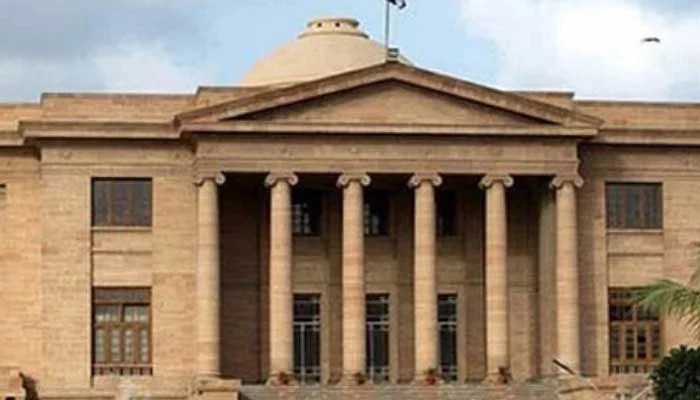
The Sindh High Court (SHC) has taken exception to unexplained delay and lack of progress in the Yellow Line Bus Rapid Transit (BRT) system and observed that prima facie it reflected serious negligence and raised a legitimate question as to whether the investigation was being deliberately delayed in order to extend undue benefit to the accused persons or otherwise prejudice the prosecution case. The high court also inquired the Anti-Corruption Establishment (ACE) to explain why the matter should not be referred to National Accountability Bureau (NAB) chairman for examination and further probe.
The observation came on a petition of former project director of Yellow Line BRT Zameer Abbasi who sought quashment of proceedings against him in a case pertaining to alleged financial irregularities to the tune of Rs8.5 billion in the project. Abbasi and others were booked by ACE over alleged misuse of authority and advance payment of Rs8.5 billion to contractors of the Yellow Line BRT project in violation of the contract that caused significant financial losses to the Sindh government.
A division bench of the SHC headed by Justice Mohammad Saleem Jessar observed in its order that it had been noticed that ACE, District South, after completing an inquiry under the Sindh Enquiries and Anti-Corruption Rules, 1993, and obtaining the requisite approval from ACC-I headed by the chief secretary, lodged an FIR on May 29, 2026 for offences punishable under the sections 409, 420, 467, 468, 471 and 477-A read with the section 34 of the Pakistan Penal Code, as well as the Section 5(2) of the Prevention of Corruption Act, 1947.
The high court observed that although the investigation was undertaken, no report, despite the lapse of considerable time, had been submitted yet before the competent court under the Section 173 of the Code of Criminal Procedure (CrPC). The SHC observed that the statutory scheme embodied in the CrPC's Section 173 required investigation to be completed without unnecessary delay and contemplated its completion within 14 days. The high court observed that in the present case, the position assumed greater significance because prior to registration of the FIR, a formal inquiry had already been conducted under the Sindh Enquiries and Anti-Corruption Rules, 1993, during which ACE had sufficient opportunity and time to examine the relevant record and material.
The SHC observed that it was only upon formation of a prima facie view regarding commission of the alleged offence that approval was sought and the FIR was ultimately registered against the petitioner and others. A provincial law officer said that compliance with the earlier order had already been made and the petition, being premature and devoid of merit, may be dismissed while permitting the respondents to complete the investigation.
The SHC inquired the law officer as to the nature of such compliance on which he was unable either to place on record any document substantiating the assertion or to furnish any plausible explanation for the continued non-conclusion of the investigation and non-submission of the report under the Section 173 of the CrPC. The high court observed that the plea of compliance remained unsupported by the record.
The SHC observed that the continued and unexplained failure of the investigation agency to submit a report prima facie reflected serious negligence and raised a legitimate question as to whether the investigation was being deliberately delayed. The high court directed ACE and other respondents to explain why, in view of such unexplained delay and apparent lack of progress, the matter should not be referred to the NAB chairman for examination and further probe in accordance with the law.
The SHC observed that the subject matter concerned a major public-sector infrastructure project in Karachi, namely the Karachi Mobility Project (KMP) for the Yellow Line Bus Rapid Transit system, being undertaken with the involvement of the World Bank, including, inter alia, the construction contracts relating to the new Jam Sadiq Bridge, Depot-I at Dawood Chowrangi and Depot-II near the Indus Hospital, Karachi. The high court observed that the conduct of the ACE chairman also required explanation, particularly with regard to the apparent failure to ensure compliance with the statutory mandate as well as the directions of the court.
The SHC issued a show-cause notice to the ACE chairman, through the secretary of the Establishment Division Cabinet Secretariat, Islamabad, calling upon him to explain why appropriate disciplinary proceedings should not be initiated against him for the aforesaid negligence. A single bench of the SHC had earlier granted bail to the former Yellow Line project director in the case pertaining to alleged financial irregularities to the tune of Rs8.5 billion.
The bench had observed in its bail order that only allegation against the applicant was that no bank guarantees as per the prosecution were asked for at the time of making an additional payment, which was done so after obtaining approval from the competent authority. The high court had also observed that the investigation agency had not worked properly and left several lacunas in the investigation of the case and proper procedure for inquiry and investigations under the anti-corruption laws were not adopted.