
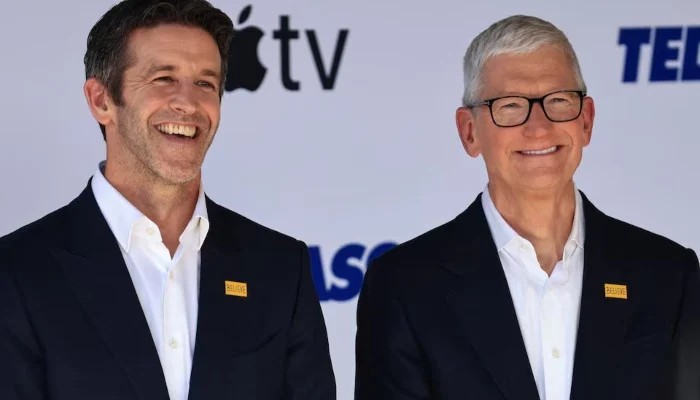
When Tim Cook took over as Apple's CEO, he did not try to fill the big shoes of its legendary founder and product visionary Steve Jobs. Instead, he took Jobs' advice: "Never ask what I would do, just do the right thing." Fifteen years on, having taken the iPhone maker from a $350 billion company to a more than $4.5 trillion behemoth, Cook will pass the baton to Apple hardware chief John Ternus, who will be steering the company in the AI era.
Cook will become executive chairman on September 1, guiding Apple's dealings with policymakers amid tense relations between its home market, the US, and China, where many of its products are made. The transition caps one of the most consequential CEO tenures ever. Unlike Jobs' product design genius, Cook ascended the Apple ladder by making the company's supply chain the envy of every manufacturer.
As CEO, Cook used this operations-first mindset to take Apple's cutting-edge products to the masses. In a perfect example of his business acumen, Cook understood Apple could make money from the customer long after the iPhone sale, turning the 2.5 billion installed iPhone user base into a recurring revenue machine. That business has outpaced growth in the company's hardware business in recent years.
Apple's annual sales rose from $108 billion at the start of Cook's tenure to $416 billion in the last fiscal year, while profit grew more than fourfold to $112 billion. Its wearables business, home to Cook-era iPhone accessories such as the Apple Watch and AirPods, brought in $35 billion in sales in fiscal 2025.
"Not only did Cook create his own path of operational and supply chain success, but he also created a 'values-driven' culture within Apple," said Christopher Brown, a financial adviser at private wealth management firm Synovus Securities, which holds the iPhone maker's shares. "What followed was a consumer brand loyalty and dependency flywheel that generated trillions of dollars in revenue."
Apple disclosed in a filing on Tuesday that Ternus' annual salary was increased to $3 million. There will also be an annual equity award with a $55 million target value, starting 2027, a majority of which will be tied to the company's stock performance. Cook, meanwhile, will earn $2 million annually, effective September 26, and restricted stock units in 2027 with a target value of $45 million.
Critics have long accused Apple of losing its innovation edge in the Cook era. Cook, they say, has failed to answer what comes after the iPhone, as hardware rivals look to displace the smartphone as the default consumer device. Cook's tenure had other misses: a decade-long EV project Apple scrapped in 2024 just as they took off in China.
The company also famously botched the launch of Apple Maps in 2012, months after Cook took charge, leading to the departure of close Jobs collaborator and software chief Scott Forstall. Apple's bet on the Vision Pro augmented-reality headset, which debuted at a whopping $3,499 in 2023, failed to produce strong sales, and its products have lagged in AI features, including delays in revamping Siri.
"AI is the single biggest challenge for Ternus. Apple needs to demonstrate that AI will be more than a gimmick," industry analysts note. Beyond AI, the pressure to continue to remove manufacturing from China without pressuring margins is a tall task, though part of that process is already underway.