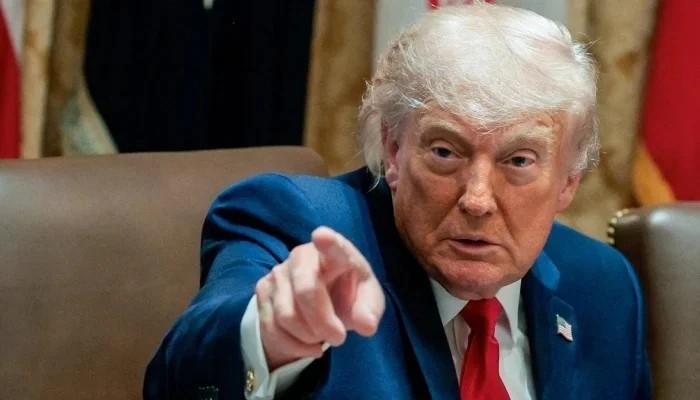
President Donald Trump said on Thursday that the United States is not talking with Iran as Washington focuses on punishing Tehran economically, vowing to penalize countries that do business with the Islamic Republic. "We don't want to speak to them. We're not looking to meet or anything," Trump told reporters in the Oval Office. Earlier in the day, White House Press Secretary Karoline Leavitt said the US economic campaign would continue until Iran decides to negotiate meaningfully. "Now we have Operation Economic Outcast to destroy their economy," Leavitt told the Fox & Friends program. "No negotiations are happening right now, and this will continue until the president feels that maybe they come to the table in a meaningful way... He of course continues to retain all options on the table."
US Treasury Secretary Scott Bessent warned countries on Monday to cut their financial ties with Iran or face secondary sanctions as part of what had been billed as "Economic D-Day," but the Treasury Department stopped short of actually imposing penalties. When asked on Thursday if he would punish Russia for continuing to do business with Iran, Trump responded: "It depends. So far, I think Russia's behaved quite well, having to do with the Strait of Hormuz, and you have to understand: for everything they do, we do also. You know, somebody was saying about China. We hear they're spying. We spy on them too." Then when asked if he would sanction Chinese banks for doing business with Iran, Trump said: "Who said I'm not? You don't know if I'm doing it... I don't have to announce everything, do I?"
Iran's top diplomat met his Qatari counterpart on Thursday in Tehran for talks on the strategic Strait of Hormuz, as a US naval blockade squeezes oil supplies to Iran amid a domestic shortfall. The visit by Qatar's Foreign Minister Sheikh Mohammed bin Abdulrahman Al Thani follows a week of intense diplomacy in Iran involving separate meetings with Oman's top diplomat and senior Pakistani officials seeking ways to end the Middle East war and reopen Hormuz. It also comes as Washington threatens wider secondary sanctions against countries, banks and companies that continue doing business with Iran, part of a broader campaign it has called "economic asphyxiation".
Iranian state television said Al Thani, who is also Qatar's prime minister, had met with Iranian Foreign Minister Abbas Araghchi, without providing details. In a statement after the talks, Al Thani said they focused on efforts to de-escalate tensions and boost security in the region. "Qatar believes that dialogue and diplomacy remain the best way to overcome crises," he wrote on X. Qatar's foreign ministry said they discussed the proposed framework for Hormuz between Iran and Oman. "Talks stressed the importance of respecting freedom of navigation in the Strait of Hormuz in accordance with international law," Al Thani added.
Alongside mediator Pakistan, Qatar had played a key role in securing an April ceasefire and June deal between Iran and the United States, but those deals have since collapsed. On Wednesday, Iran's Vice President Mohammad Jafar Ghaempanah said the blockade had prevented his country from importing enough petrol to cover a shortfall in domestic production. As the US seeks to strangle Iran's economy, Iranian officials have dismissed the measures as "failed policies" that will not force Tehran to change course. "The country is in an all-out economic war," said Iran's chief negotiator.