
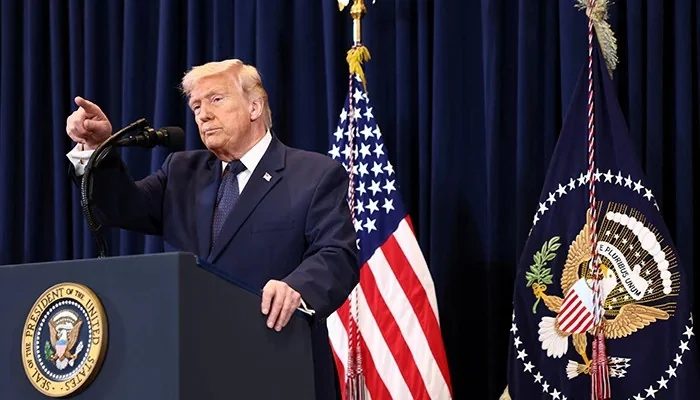
President Donald Trump announced new tariffs on 14 trading partners on Wednesday, targeting China, Japan and the EU.
- Tariffs ranged 20‑40% but were capped under existing trade deals.
- Brazil faced a new 10% tariff on Embraer aircraft.
- China's rate could rise to 40% if the trade truce ends.
Tariff Announcement
Trump fired a new tariff salvo on 14 major trading partners, including China, Japan and the European Union. The administration proposed headline rates of 20 per cent to 40 per cent, but said duties would be capped at lower levels agreed under trade deals that had already been concluded or were under negotiation. Separately, the United States Trade Representative (USTR) proposed a 10 per cent tariff on imports of Brazil's finished Embraer commercial aircraft and raised duties on Brazilian sugar that exceeded quotas. Those products had previously been exempted from Trump's 25 per cent tariffs on Brazilian goods imposed in July. A US official said that despite negotiations, there were "substantial differences" over the allegations.
Under the main Section 301 probe into excess industrial capacity, China would face the highest capped rate of 20 per cent, which would be added to duties of roughly 25 per cent imposed during Trump's first term. That rate complied with a US‑China trade truce that expired on January 10. If the truce unraveled, China's rate would rise to 40 per cent, the USTR said. Vietnam would face a capped tariff rate of 20 per cent if it reached a trade agreement with Washington, rising to 35 per cent if negotiations failed. The USTR said the tariffs would not take effect until after a January 25 public hearing and were intended to counteract industrial strategies that undermine the US manufacturing base.
Trump's administration has long accused China of subsidizing industry and flooding global markets with low‑cost exports ranging from steel to electric vehicles and solar products. Beijing earlier reiterated its opposition to "trade wars" and rejected allegations of overcapacity, but stopped short of threatening retaliation. Foreign Ministry spokesperson Guo Jiakun called the "overcapacity" issue a false issue and urged the world's top two economies to maintain stable relations.
Other Capped Rates
The USTR also proposed capped tariff rates of 18 per cent for imported goods from Cambodia, Indonesia, Malaysia, Thailand and Bangladesh, and 15 per cent, including existing Most Favoured Nation duties, for Japan, South Korea, Taiwan, the EU and Switzerland. India, which had yet to reach a trade deal with the Trump administration, would face a 17 per cent tariff rate if an agreement was finalized and a 25 per cent rate if talks failed. Singapore would receive a capped tariff rate of 10 per cent. Greer told CNBC that the caps were consistent with trade agreements reached over the past year that lowered barriers to US exports. Mexico and Norway were excluded from the proposals because investigations into their trade practices remained underway.
Market Reaction
Even so, the prospect of new trade barriers weighed on stock markets on Wednesday amid a renewed selloff in tech stocks. Major US indexes opened down more than 1.0 per cent, with the tech‑heavy Nasdaq composite down more than 3.0 per cent. ING analysts wrote that the legal justification for tariffs keeps changing, but US protectionism is becoming increasingly difficult to unwind.
Trump's tariffs have contributed to higher prices for US consumers, and he has long vowed to restore duties struck down by the US Supreme Court in February. The latest measures followed an eight‑month investigation into unfair trade practices under Section 301 of the Trade Act of 1974. Greer said the proposed tariffs would not apply to about $30 billion of Chinese imports under consideration for tariff reductions through a bilateral mechanism known as the Board of Trade. However, the new duties would be added to tariffs imposed on Chinese goods during Trump's first term, which totaled roughly 25 per cent. They would not be imposed on top of the 10 per cent and 12.5 per cent tariffs introduced in July on a broader group of 60 trading partners over allegations of lax enforcement of anti‑forced‑labour laws.