
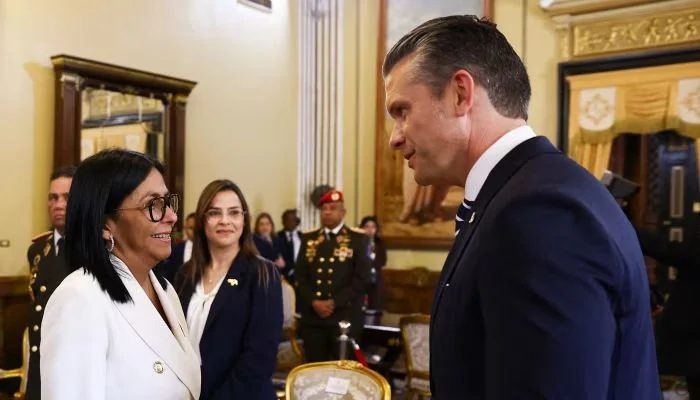
The United States signed a defence cooperation agreement with Venezuela on Wednesday, restoring military ties between Washington and Caracas after a 21-year hiatus. Secretary of War Pete Hegseth met interim President Delcy Rodriguez in Venezuela to finalize the historic pact, marking a major geopolitical shift in South America.
- The agreement establishes a framework for joint military training, intelligence sharing, and enhanced border security to combat transnational crime.
- This pact marks the first visit by a U.S. defence secretary to Venezuela in the current century, ending a period of isolation that began in 2005.
- The deal follows a significant economic realignment three months ago, in which Washington secured commercial interests in 17 Venezuelan oilfields.
Venezuela and United States Defence Pact
The comprehensive deal includes joint military training exercises, intelligence sharing mechanisms, and enhanced border security cooperation to combat regional transnational crime. Washington had already secured strategic commercial interests in 17 Venezuelan oilfields three months prior to this diplomatic breakthrough.
Secretary of War Pete Hegseth's visit to Venezuela on Wednesday marked the first time a U.S. defence secretary traveled to the country in the current century. The agreement formally ends a prolonged period of diplomatic and military isolation that began in 2005, when former Venezuelan president Hugo Chavez terminated all military cooperation with Washington, accusing American intelligence officials of conspiring against his administration.
The newly established framework focuses heavily on joint military training, intelligence sharing, and strengthening border security to effectively combat drug trafficking networks operating across the region. Interim President Delcy Rodriguez, who previously served as vice-president under Nicolas Maduro, expressed strong interest in acquiring advanced American military technology during the high-level discussions.
Rodriguez stated publicly that the government intends to modernize the Venezuelan armed forces through this strategic partnership with the United States. This military agreement follows a significant economic realignment that occurred three months ago, when Washington secured commercial interests in 17 major Venezuelan oilfields, which contain approximately one-fifth of the nation's total petroleum reserves.
Secretary Hegseth maintained during press briefings that this energy and security agreement could significantly reduce the Western Hemisphere's dependence on energy shipments passing through volatile maritime passages such as the Strait of Hormuz. Energy analysts have noted that this move brings Caracas and Washington closer on global commodity markets.
Political Instability in Caracas
Despite the diplomatic rapprochement, the political situation in Caracas remains exceptionally complex and fluid. The United States captured President Nicolas Maduro ten months ago in a high-profile operation, and he currently remains in American custody alongside his wife amid ongoing legal proceedings.
Both individuals face serious criminal charges brought by federal prosecutors, allegations which they consistently and strongly deny. Meanwhile, prominent opposition leader Maria Corina Machado recently returned from exile, creating new dynamics within the domestic political opposition movement.
Despite the return of key political figures, local election authorities have not yet announced a definitive date for upcoming presidential elections. This delay has fueled uncertainty among political analysts regarding the timeline for a transition to full democratic governance.
Many ordinary Venezuelans have expressed deep concern regarding Washington's rapidly growing influence over domestic affairs. Citizens noted that they had initially hoped the removal of Maduro would lead directly to immediate and transparent democratic elections without foreign military entanglement.