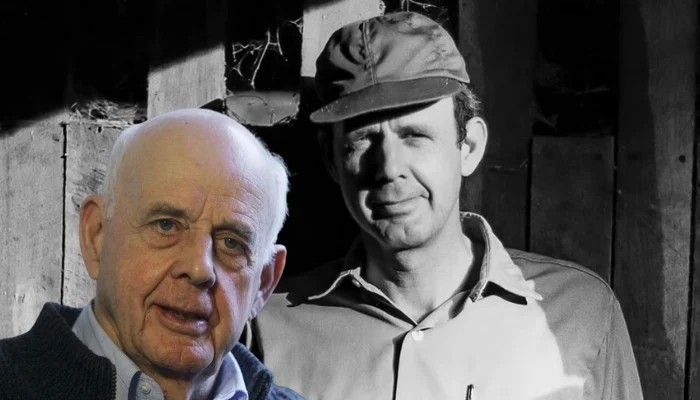
Wendell Berry, the poet, novelist, essayist and agriculturalist, whose writings inspired generations, passed away at age 92. His writings often take his words to places he himself never visited, bringing admirers from around the world to Kentucky searching for him. Berry died on Monday, August 31, at his home in Port Royal, Kentucky.
Berry, through his work, emerged as America's most prolific writer on land, work, and community and left an indelible mark on American literature. A lover of forests, the farmer, author and former English professor once described what it means to be a conservationist: "Beware the machinery of longevity. When a man's life is over the decent thing is for him to die. The forest does not withhold itself from death."
Berry was born in Louisville to Virginia Erdman and attorney John Marshall Berry in 1934. He was raised in Henry County, where his family had been farming for generations. He pursued his bachelor's and master's in English from the University of Kentucky, according to the Kentucky Historical Society.
During his time at the university, he studied under the acclaimed novelist Wallace Stegner and alongside classmates Larry McMurtry, Ken Kesey, Ernest Gaines and Edward Abbey. He then headed back to the U.S. and started teaching at the University of Kentucky from 1964 to 1977 and again from 1987 to 1993.
He had also taught at Stanford University, Georgetown College, New York University, the University of Cincinnati, and Bucknell University. Throughout his life, he continued to uphold the cause of farmers, land, and work through his writings and non-fiction. His literary work includes over 40 published volumes, including novels such as Nathan Coulter and A Place on Earth, alongside the collection A Timbered Choir: The Sabbath Poems (1979-1997).
The most iconic work among all was the 1977 release of The Unsettling of America: Culture & Agriculture, which became a defining work in the push for sustainable farming. He challenged modernism as something to defy and emphasised the need to safeguard and ethically use land as part of nature.