
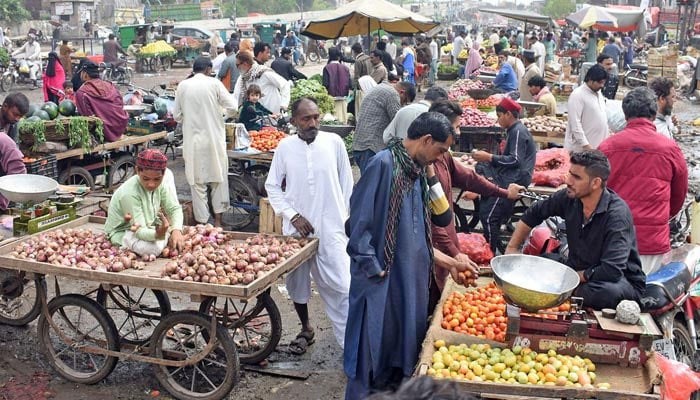
The underlying structural deficiencies and fundamental causes of the inflation crisis must be addressed promptly to prevent further deterioration, if the nation aims to strengthen its economic foundations, according to prominent economists and data gathered by While mainstream discourse characterises inflation through the lens of macroeconomic stability indicators, rigorous data examination and specialist analysis reveal a more profound, internally generated crisis. The significant supply chain disruptions, gaps with regional countries, inequitable tax structures and flawed regulatory frameworks highlight the economic difficulties Pakistan currently confronts.
Regional disparity in inflationary pressure demonstrates how substantially Pakistan lags behind its neighboring economies. Throughout 2023-2024, Pakistan's hyperinflation exceeded the South Asian average by 3.7 times. Whereas Sri Lanka, similarly affected by hyperinflation, successfully reduced its import-dependent inflation from 17.4 percent to -0.5 percent by 2025, Pakistan's temporary decline to 4.5 percent subsequently began reversing.
Renowned economist Dr Shahid Hassan Siddiqui references recent State Bank of Pakistan figures indicating inflation climbing back into double-digit territory - reaching 9.2 percent in July 2026 and 11.1 percent in August 2026. By comparison, August 2026 inflation measured merely 4.5 percent in India, 1.8 percent in Malaysia, 3.2 percent in Indonesia and 2.5 percent in Thailand. Official Asian Development Bank statistics similarly position Pakistan alongside Bangladesh among the region's highest inflation rates, he concludes.
According to data, transportation sector monopolies and fuel taxation imbalances have been identified as primary drivers of this sustained inflationary pressure. Diesel pricing in Pakistan exceeds neighboring Asian nations by approximately 30 percent, directly raising transportation expenses throughout all consumer markets. Fuel is heavily taxed, putting additional burden on economy.
Consequently, structural economic weaknesses have elevated Pakistan's logistics expenditure to 15.6 percent of GDP - one-seventh of national output - compared to 8-9 percent in India, rendering every fuel surcharge an effective inflation mechanism. India runs rebalancing transportation multimodal system while Pakistan is almost entirely road-locked. In India, rail rising to 31 percent, with target of 45 percent by 2030 via Dedicated Freight Corridors, while inland expanding waterways gives another edge.
Pakistan is the opposite as road carries 96 percent of freight and 93 percent passenger vs just 4 percent rail. It is in sheer contrast to Vision 2025 target of 20 percent. There is no inland water freight on the Indus despite having potential, Karachi and Port Qasim already congested while Gwadar lacks smooth access and completely cut off from railway connectivity.
Seasoned economist Dr Ashfaque H Khan points out that while other nations cut taxes during international oil spikes to shield consumers, Pakistan imposed a Petroleum Levy exceeding Rs100 per litre to cover government spending failures. He warns that using this levy as easy revenue severely damages the economy by escalating transport costs that are immediately passed onto citizens. The distorted energy, infrastructure bottlenecks and missing policy frameworks emerged as daunting challenges.
Furthermore, the nation possesses zero LNG storage capacity and lacks strategic fuel reserves in critical regions like Balochistan to absorb external price and supply shocks. In the LPG sector, poor households pay double the officially notified rates for contaminated gas transported in substandard, uncertified tanks, bowsers and cylinders. LPG as autogas is a viable option but no step is being taken in this direction.
The structural inefficiencies due to fuel-side disruption or high cost cripple national output. Power outages force factories to run generator backups at 2-3 times the grid cost, breaking industrial cold chains and spoiling agricultural yield. Former minister Hussain Jahania Gerdezi asserts that Pakistan's inflation outpaces its neighbors because the core economy is failing under International Financial Institution (IFI) recipes that prioritise debt servicing over economic revival.
Well-known agriculturist Ibrahim Mughal adds that exorbitant energy tariffs have pushed Pakistan completely out of production cost competition, weakening farm output and exports and eroding general economic stability. To break this cycle, he emphasises permanent steps for availability of affordable fuel and expanding both grid-connected and off-grid solar solutions to cut reliance on costly energy.