
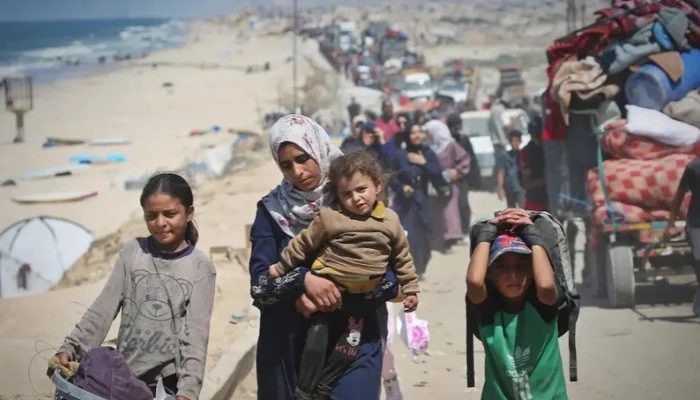
Last December, UNICEF's Catherine Russell met a girl in Sudan named Nahed. She was 16 when war broke out.
Her family fled Khartoum, Sudan for a village they believed was safe, but the war followed them. Armed men attacked, killing her grandfather and uncle.
Girls were raped and abducted. Nahed escaped, though what she witnessed didn't leave her.
Russell told the UN Security Council that behind every violation is a child whose life may never be the same. The sentence is worth holding onto, because everything that follows is arithmetic, and arithmetic has a way of making suffering feel tidy.
The numbers, however, are not today. The Peace Research Institute Oslo, in an analysis commissioned by Save the Children, estimates that 520 million children, 20.7% of the world's children, lived in a conflict zone in 2024.
That is the highest figure ever recorded. In the mid-1990s the share was about one in ten.
The method deserves precision. A child counts as affected if she/he lives within 50 kilometers of a lethal conflict event.
A radius chosen because violence at that distance disrupts daily life through insecurity, displacement, and lost services. It is a measure of exposure, not of injury.
Even so, it describes a planet where it has become an ambient condition of childhood. Africa has now both the largest number of affected children (218 million) and the highest share (32.6%).
The UN's own tally is narrower and grimmer. It has verified more than 430,000 grave violations against children since 2005, more than 38,000 of them in 2025, the highest annual figure since the Council took the issue.
The worst-affected places were the State of Palestine, the Democratic Republic of Congo, and Nigeria. It is important to note that these are the only cases the UN could verify.
In war, the verifiable is a floor, not a ceiling. The pattern of harm is telling.
More than 70% of verified child casualties in 2025 came from explosive weapons, which also destroyed the schools, hospitals, and water systems that sustain children afterward. The UN recorded more than 8,000 incidents of denied humanitarian access that year.
Government forces, not only insurgents, were responsible for the majority of verified violations. Not all damage arrives with a blast.
Girls in conflict zones are about 2.5 times more likely than boys to be out of school, and less likely to return. School closure, the statement warns, raises the risk of exploitation, early marriage, and recruitment.
This is where the story turns from the visible to the invisible. A child out of school is not a casualty in any dataset of violations, yet she has lost one of the strongest protections she had.
Her loss is also a society's loss. Since Graça Machel's 1996 report, which found that 2 million children had been killed in conflict in the preceding decade, the world has built monitoring mechanisms, signed more than 40 action plans with parties to conflict, and secured the release of more than 220,000 children from armed forces and groups.
And still the trajectory worsens.