
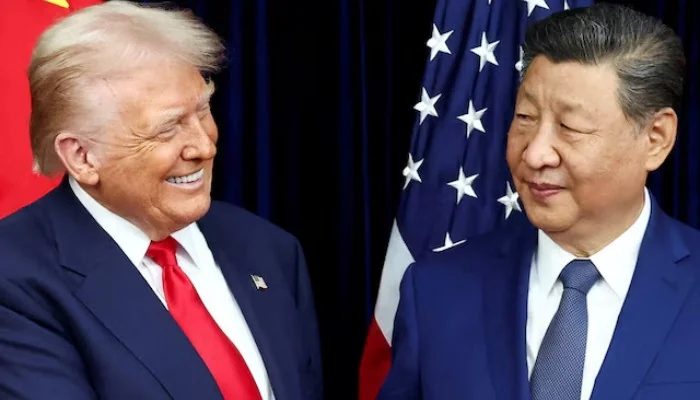
SHENZHEN: The prospect of tighter US curbs on China's access to advanced AI chips will likely overshadow talks when US President Donald Trump and President Xi Jinping meet at a summit in Shenzhen this week, analysts said, though the leaders could make some progress on AI safety cooperation.
- "If we are moving from strategic stability to strategic containment, that's a big shift and that's what Beijing is watching," Chen said.
- Three people briefed on preparations for the talks said the two sides had planned further AI discussions around the Shenzhen summit to cover safeguards against the misuse of the technology.
- They did not say what exactly is delaying the setup of the safety mechanism.
The meeting on Thursday comes days after Nvidia co-founder Jensen Huang, who starred at the US-China summit in Busan a year ago promoting chip sales, resigned following reports of an affair with a suspected Chinese spy. The scandal has spurred a push by US lawmakers to tighten China's access to advanced AI chips, a move analysts said Beijing would be bracing for.
"President Xi may not name or mention Jensen Huang, but I'm pretty sure export controls will be high on the agenda when he meets Trump," said George Chen, chair of digital practice at The Asia Group, a consultancy. The Chinese government's key concern, he said, was not just technology controls but whether the US would seek to contain China's broader technological and economic rise.
"If we are moving from strategic stability to strategic containment, that's a big shift and that's what Beijing is watching," Chen said. Despite their rivalry, Washington and Beijing have been exploring the prospect of cooperation on the risks posed by increasingly powerful AI systems.
Three people briefed on preparations for the talks said the two sides had planned further AI discussions around the Shenzhen summit to cover safeguards against the misuse of the technology. A proposed emergency mechanism to notify each other of serious AI incidents, discussed by US Treasury Secretary Scott Bessent and Chinese Vice Premier He Lifeng in September, has yet to become operational, according to several people familiar with the discussions.
They did not say what exactly is delaying the setup of the safety mechanism. The mechanism is intended to help prevent AI-related incidents or misunderstandings from escalating into national security crises.
Communication has so far relied largely on direct contacts between senior officials, the people said. Bessent said in New York last week that both sides would discuss communication protocols for AI safety incidents at the APEC AI talks and expected to exchange best practices for testing advanced models.
"Right now, I don't think it's in the interest of either side to let the potential export control squeeze sour the leaders' summit," said Bo Zhengyuan, Shanghai-based partner at research consultancy Plenum. CHINA AIMS FOR PRACTICAL STEPS ON AI: The US and China will not announce any further progress on the Board of Trade initiative, agreed at the Trump-Xi summit in Washington in September, to lower reciprocal tariffs on $30 billion worth of goods, a senior US administration official said.
China has identified AI and the digital economy as priorities for the Asia-Pacific Economic Cooperation forum in Shenzhen, with Foreign Ministry spokesperson Mao Ning saying Beijing hoped leaders would reach practical agreements in both areas. Requests for comment to China's Commerce Ministry and the US Treasury were not immediately answered, while the US administration official said President Trump was not bringing a formal business delegation with him, adding that Elon Musk was not among the chief executives traveling with Trump.