
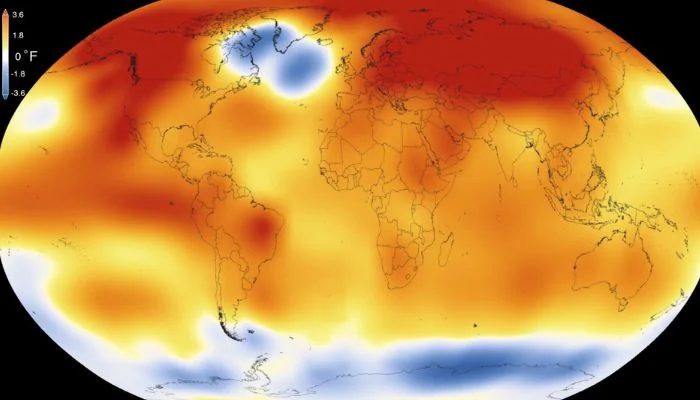
Scientists warned on November 14, 2026, that a cooling patch south of Greenland could shift global weather patterns by 2067. Scientists described the cold blob as a vast patch of cooling water in the subpolar North Atlantic south of Greenland that had cooled nearly 1 °C since 1900.
- They linked the cooling to a slowdown of the Atlantic Meridional Overturning Circulation, the ocean current that transports warm water northward and keeps Europe mild.
- Research from Penn State, published in Nature Communications, showed that the relationship between the AMOC and the cold blob follows three distinct phases rather than a uniform connection.
- Oxford academics reviewed 91 national adaptation plans submitted to the UN and found that only Brazil and Ireland mentioned the AMOC.
They linked the cooling to a slowdown of the Atlantic Meridional Overturning Circulation, the ocean current that transports warm water northward and keeps Europe mild. Climate change melted the Greenland ice sheet, adding fresh water that floated on the surface and prevented salty water from sinking, weakening the AMOC's engine.
Research from Penn State, published in Nature Communications, showed that the relationship between the AMOC and the cold blob follows three distinct phases rather than a uniform connection. Simulations projected that the AMOC would decline to its lowest‑strength regime by 2100, with the cold blob's most pronounced temperature shift occurring as early as 2021 or as late as 2067.
Oxford academics reviewed 91 national adaptation plans submitted to the UN and found that only Brazil and Ireland mentioned the AMOC. They warned that a collapse could bring winter cold extremes of · 20 °C in London and weaken West African and Indian monsoons, urging governments to stress‑test long‑term investments against such scenarios.