
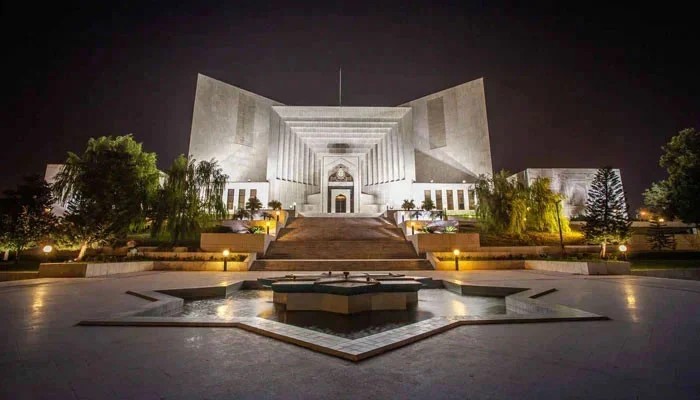
The Supreme Court has held that true dower is given with a good heart, at the time agreed, without conditions that demean the wife, and when it is not given, the courts must step in, not with hesitation, not with apology, but with the full authority of the law. A four-member larger bench of the apex court, headed by Justice Shahid Waheed and comprising Justice Irfan Saadat Khan, Justice Aqeel Ahmed Abbasi and Justice Shahid Bilal Hassan, issued the judgment in a set of cases decided by high courts regarding disputes involving dower recorded in the Nikahnama.
"Before parting, we wish to emphasise that we must not allow the institution of marriage to be reduced to a transaction where the wife's rights are an afterthought," said the 26-page judgment authored by Justice Shahid Waheed. "We must not allow the husband to treat dower as a weapon to be used in later disputes. I will pay you if you behave; I will pay you if you do not ask for divorce.
That is coercion," the court held. "It is to tell every man that he can make promises before Allah and before the law and then ignore them," it said, adding that it is to weaken the family and, through the family, to weaken the nation. The court noted that in every case that comes before a court involving dower, the court must begin with this premise: the wife's dignity is at stake.
"Her right is not a favour, but it is a command of the Shari'ah, a command of the statute, and a command of justice," the court held, adding that its task is to determine, on evidence, what that right is, and then to ensure that it is fulfilled. "Let no husband think that he can escape this liability by silence. Let no court think that it can dispose of this matter lightly.
For in protecting dower, we are protecting the home. By protecting the home, we protect society. And in protecting society, we are fulfilling the promise of a nation that claims to be founded on the principles of Islam, justice, and human dignity," the court held.
Meanwhile, in his additional note, Justice Shahid Bilal Hassan held that dower is not a consideration proceeding from the husband for the contract of marriage, but it is an obligation imposed by law on the husband as a mark of respect for the wife, as is evident from the fact that non-specification of dower does not affect the validity of marriage. The dower's importance under Islamic law is evidenced from the fact that it satisfies various functions which lead to the success and prosperity of the marital relationship between the spouses, the judge noted.