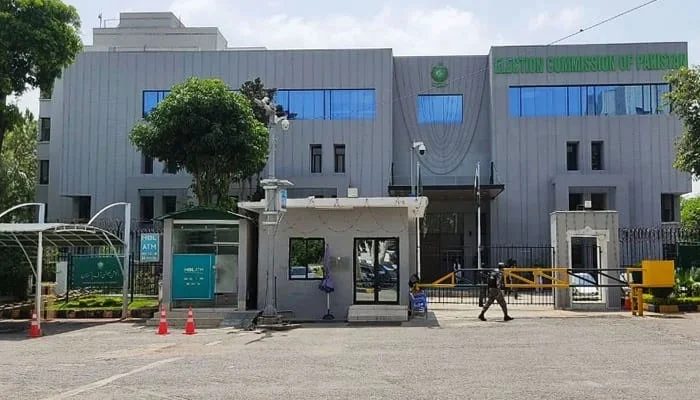
The Election Commission of Pakistan (ECP) on Monday called on the Punjab government to respond to the draft election schedule at the earliest and sought lists of officials for appointment as district returning officers (DROs), returning officers (ROs) and assistant returning officers (AROs) for the conduct of local government (LG) elections. A meeting was held at the Election Commission Secretariat to review preparations for and the conduct of LG elections across the provinces, the Federal Capital and cantonment boards.
The meeting was presided over by Chief Election Commissioner Sikandar Sultan Raja and attended by ECP members Nisar Ahmed Durrani, Shah Muhammad Jatoi and Justice (retd) Ikramullah, as well as the Election Commission secretary and other senior officials. The electoral body noted that legal and administrative issues continued to impede its efforts, despite its preparedness to hold LG elections in the Federal Capital, Khyber-Pakhtunkhwa, Quetta and cantonment boards.
The ECP said it was ready to hold Punjab's local government elections and had sent the provincial government a draft schedule. For Islamabad, delimitation wascomplete but the Federal Capital Amendment Ordinance 2026 had expired. The ECP decided to approach the federal government for immediate legislation, warning that otherwise elections would be held under the Islamabad Capital Territory Local Government Act, 2015.
For cantonments, delimitation was also complete and the ECP was ready for elections, but the federal government had yet to formally request them as required under Section 19-D(2) of the Cantonments Act, 2023, despite repeated reminders and a letter from the Chief Election Commissioner to the prime minister. The ECP decided to send a final letter to the Defence Ministry before taking an appropriate decision. In relation to Khyber Pakhtunkhwa, the meeting was informed that delimitation had been completed in 23 districts, while the process was still underway in seven districts.
The ECP noted that Khyber Pakhtunkhwa's revised population threshold for village and neighbourhood councils, increased from 5,000-15,000 to 30,000-40,000, conflicted with the number of councils in the Ninth Schedule, making delimitation unfeasible. It urged the provincial government to amend the schedule, but no action was taken. The ECP was informed that existing local governments would expire on February 8, 2027, while Quetta's elections remained pending despite a Federal Constitutional Court order.
Although delimitation was completed by May 21, 2026, the provincial government's subsequent division of Quetta into two districts without providing boundary details delayed the process. The ECP decided to direct the government to finalise the required legislation and comply with the court order.Preparations for local government elections had also begun in Sindh.