
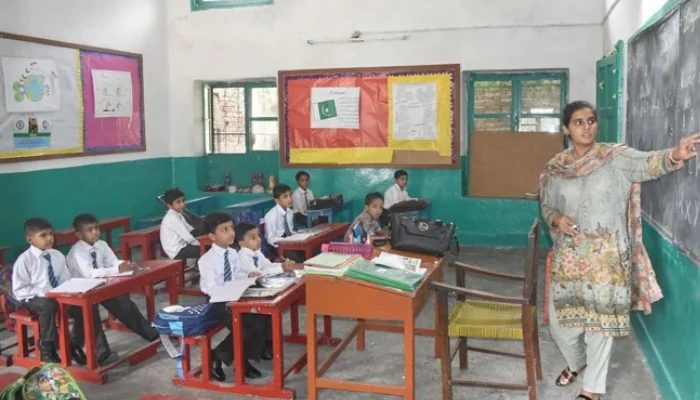
Educationists released a comprehensive reform blueprint for Pakistan's schooling system on November 16, 2026, targeting curriculum overhauls to build national competence. Curriculum reform must replace colonial-era educational models that reward memorisation.
- Foundational learning targets reading, numeracy, and mother-language early instruction.
- Every institution Pakistan will possess in 2047 will depend on people being formed in classrooms today.
- Curriculum reform therefore belongs at the centre of the development agenda, raising the fundamental question of what kind of Pakistani the education system intends to produce.
Foundational learning targets reading, numeracy, and mother-language early instruction. Board examinations and university entry tests must transition toward comprehension.
Every institution Pakistan will possess in 2047 will depend on people being formed in classrooms today. Their competence, integrity and capacity for judgment will become the competence, integrity and judgment of the nation.
Curriculum reform therefore belongs at the centre of the development agenda, raising the fundamental question of what kind of Pakistani the education system intends to produce. Thomas Babington Macaulay answered that question for an empire in 1835.
His Minute on Education sought a class who could act as interpreters between colonial rulers and the people they governed. Language, examinations and classroom authority served that purpose, where accurate reproduction mattered more than independent inquiry.
Independence changed constitutional destiny, but too much of this educational design survived. This imprint appears whenever English fluency passes for intelligence, an examination rewards memorised answers, or a family income determines which educational world a child enters.
Successive reforms revised content while leaving these incentives largely intact. Textbook publishers, tuition markets and admission systems continue to respond to the same predictable paper.
Artificial intelligence made this inheritance doubly untenable. Machines now translate, summarise, draft and reproduce fluent text at extraordinary speed.
A child trained only to reproduce information prepares to compete with a machine that reproduces it faster. What remains valuable is the ability to understand a problem, ask a worthwhile question, test an answer and accept responsibility for the result.
Industry 4.0 brings automation, robotics and intelligent production into everyday life, while Industry 5.0 adds a question that no machine can answer for society: whose wellbeing does this progress serve? Students should examine the effects of technology on workers, communities and the environment and learn to make ethical choices about its use.
Advanced science can raise ambition without displacing the foundations on which genuine expertise rests. That is the purpose of the Minute on Education 2.0 offered to the education ministry, the National Curriculum Council and the provinces.
The goal involves developing knowledgeable, capable and ethical Pakistanis with the confidence to belong, the freedom to inquire and the ability to create value for their country and humanity. This ambition grows naturally from intellectual tradition.
The Quran invitation to read, observe and reflect gives inquiry a moral foundation, while Surah Al-Imran directs attention to the creation of the heavens and earth and the alternation of night and day. Knowledge begins in attentive observation and deepens through reflection, a spirit Iqbal carried into his challenge to move from being a reader of books to becoming an author.
Development implications remain direct. URAAN Pakistan ambitions for exports, digital transformation, climate resilience, energy security and equity depend on human capabilities.