
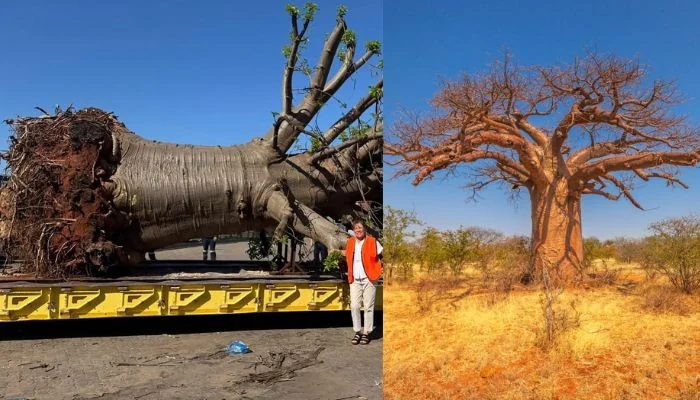
Having survived for centuries in the African wilderness, five enormous baobab trees are now fighting for survival after being uprooted for an overseas buyer. Conservationists in South Africa are racing against time to replant the trees, estimated to be between 200 to 300 years old, following an alleged attempt to illegally export them to Georgia.
- Five baobab trees, each 200-300 years old, were illegally uprooted and shipped to Georgia before being intercepted in Durban on July 17.
- The trees were left in a Durban warehouse for four months without soil, yet they survived and began blooming.
- Conservationists are transporting the trees 900 km to Timbavati Nature Reserve, where they will be secured with steel cables and electric fences to protect them from elephants.
Georgia
The shipment was intercepted by South African authorities on July 17, after it was discovered that the exporter did not have the proper permits. The trees were left to lie in a shipping warehouse parking lot in Durban for four months, exposed to the elements without any soil to sustain their massive root systems.
South Africa
Remarkably, even though their roots were severed, the trees exhibited signs of life and started producing blossoms as conservationists were readying them for their new home. This phenomenon has stunned botanists, highlighting the incredible biological resilience of the species, which is often referred to as the 'tree of life' due to its ability to store vast amounts of water.
The complex rescue operation, headed by renowned ecologist Sarah Venter, involved moving the massive trees over 900 kilometres from the coast to the Timbavati Nature Reserve. The logistics required heavy-duty cranes and specialized transport vehicles to ensure the structural integrity of the ancient trunks was maintained during the long journey.
Criminal proceedings have been formally opened against the individual in charge of the landscaping company responsible for the illegal uprooting. The court case is currently scheduled for January 15, 2027, as authorities seek to set a precedent against the exploitation of protected natural heritage.
Each tree weighs between 19 and 29 tonnes, making the relocation process an engineering challenge. Consequently, the total transport and rehabilitation costs are expected to exceed one million South African rand, a sum being covered by conservation groups and private donors.
Once successfully replanted in the reserve, the trees will be stabilized with heavy-duty steel cables to prevent them from toppling over while their root systems re-establish. Furthermore, the area will be surrounded by electric fences to protect the vulnerable specimens from being damaged by local elephant populations.
The survival of these trees remains a top priority for the South African Department of Forestry, Fisheries and the Environment. Experts believe that if the trees can survive the initial shock of replanting, they have a strong chance of thriving in their new protected habitat for another century.
This incident has sparked a national debate regarding the protection of ancient flora in South Africa. Conservationists are now calling for stricter monitoring of export permits to ensure that such a tragedy does not repeat itself in the future.
As the world watches the progress of these ancient giants, the Timbavati Nature Reserve has become a symbol of hope. The resilience shown by these baobabs serves as a powerful reminder of nature's ability to endure, provided that human intervention is directed toward preservation rather than destruction.