
History has repeatedly demonstrated that aggressors often end up leaning for conflict resolution after facing humiliating defeat on the battleground. Nazi Germany, the principal aggressor in World War II, surrendered unconditionally after the fall of Berlin in 1945, bringing the war to an end. Similarly, Argentina, having invaded the Falkland Islands in 1982, accepted a ceasefire and withdrew after its military defeat by Britain.
A similar tendency was demonstrated by India in May 2025 after facing humiliation in the aerial warfare on the night of 6th and 7th May, 2025 and later on 10th May, 2025. Embarrassment is not a new term for the Indian forces, rather their operational performance exhibits that they are destined for it. 6th September, 1965 was yet another humiliating day for the Indian military leadership, when their hopes for lunch at Lahore Gymkhana were crushed by Pakistani Armed Forces.
The, military leadership demonstrated operational excellence and resilience posing substantial loss to the Indian Forces. The enthusiasm and valour of Pakistani Armed Forces during the 17-day conflict cannot be overlooked, since numerous stories of bravery, courage and resilience are well-known in the public domain. Leadership is a personality trait bestowed upon by the ALMIGHTY to very few.
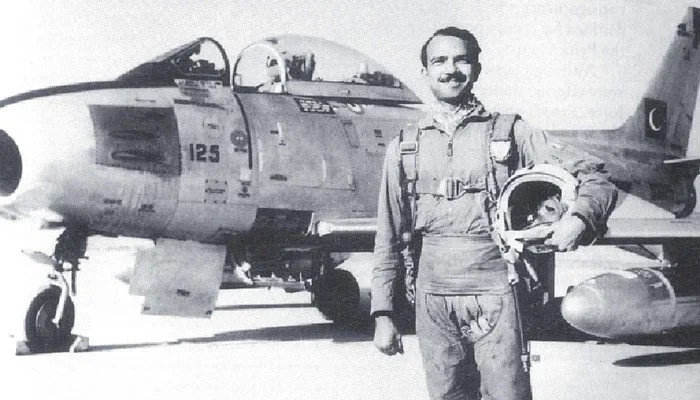
Air Marshal Malik Nur Khan and Air Chief Marshal Zaheer Ahmed Baber Sidhu are amongst those blessed leaders, who had the insight and an eye to detail perceivably the Indian aspirations well before the respective conflicts of 1965 and 2025. Air Marshal Nur Khan took command of Pakistan Air Force in July 1965, just weeks before the outbreak of the war. Yet, he had sensed the urgency of the situation and issued a red alert on 1st September, 1965 which enabled PAF to prepare well for the conflict ahead.
PAF played a decisive role throughout the conflict by not merely defending Pakistani airspace, but also inflicted serious damage to the Indian Air Force. 19 Squadron at Pathankot airfield on 6th September, shooting down of five Hawker Hunters by Squadron Leader M.M. Alam on 7th September and bombing 40 out of 72 Indian artillery regiments deployed along the BRB canal by Wing Commander Zahid Butt in C-130 Hercules are few of the well-known performances by the PAF fighters throughout the 1965 conflict.
The modus operandi of India in May 2025 conflict was no different than before. Immediately accusing Pakistan within first thirty minutes of Pahalgam attack strongly suggests a preplanned political motive by the Indian government to escalate geopolitical tensions rather than conduct a credible investigation. PAF leadership had sensed the Indian objectives and swiftly ordered the officers of entire force to be on standby in order to respond to any aggression by the Indian forces.
It was due to Pakistan Air Force's extensive operational preparedness, adaptation of modern technologies and multi-domain capabilities that the outcomes of the aerial engagement between the PAF and IAF were witnessed and concurrently acknowledged by the global community in which 08 IAF aircraft and 02 S-400 Air Defence Systems were annihilated by PAF Shaheens. ACM Zaheer Ahmed Baber Sidhu choreographed an integrated combat strategy that operated across air, cyber, space, electromagnetic and ground-based air defence domains forming a Kill Chain that brought global humiliation for IAF.
Moreover, in pursuit of the rapidly evolving global defence industry and the changing strategies of modern warfare, Air Chief has emphasised that modern warfare, particularly aerial conflicts are no longer determined by isolated kinetic superiority, but by the speed, cohesion and resilience of integrated, network-enabled & multi-domain operations. Since his appointment as Chief of the Air Staff in 2021, Pakistan Air Force, ACM Sidhu conceptualised and integrated latest frontline fighter jets including J-10C and JF-17 Thunder Block 3, while setting the foundation for acquiring 5th Generation platforms.
Likewise, cutting-edge combat drones including Bayraktar Akinci, Bayraktar TB2, Wing Loong II, Shahpar-III, Loitering Munitions & Swarm Drones were inducted for tactical saturation strikes. Additionally, operational elements of Space Domain, Cyber operations, Electronic Warfare and Ground-Based Air Defence were modernised through collaboration with the strategic partners. The results of such modernisation have been evident in the operational domain in conflicts against India and destabilising forces during last one year, as well as in the commercial sphere.
Pakistan has expanded its defence export portfolio, securing agreements that have pushed its total defence export pipeline towards roughly $10 billion mark based on exports of JF-17 Thunder and Super Mushaq aircraft to allied countries. The journey towards transformation and modernisation does not stop here. Under ACM Sidhu's far-sighted leadership, Pakistan is now focusing on the attainment of indigenous capabilities.
National Aerospace Science & Technology Parks & Pakistan Aeronautical Complex are simultaneously working to build war-winning technologies. With a foundational base of advanced combat aircrafts such as JF-17 Thunder Block III, J-10C and F-16s; and advanced munitions of hypersonic weapons, long-range air-to-air missiles and precision strike warheads; Pakistan Air Force is well-equipped to define airpower in the 2030s and beyond through stealth, sensor fusion and networked operations.
Innovation-driven autonomy through national institutions has not merely provisioned an edge to Pakistan in the regional sphere, but has also established its global repute. In the age of tech advancement and AI integration in National Security, PAF has significantly transformed the nature of modern defence systems. Global collaborations in parallel with indigenous development has enabled Pakistan to lead beyond the imagination of our adversaries, but also contribute for the Muslim Ummah through establishing.