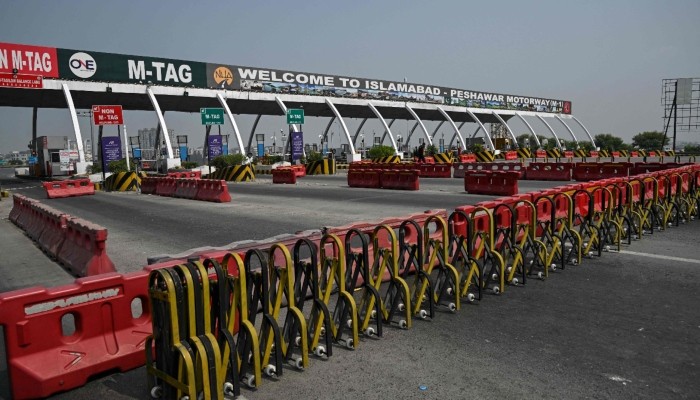
Every few months, Islamabad disappears behind a wall of steel. Shipping containers, welded end to end, seal off the arteries of a capital of more than two million people, and television screens abroad fill once again with images of Pakistan under siege from within. For diplomats, investors and international observers watching from a distance, the message is stark and unflattering: a nuclear-armed state of 240 million people cannot move its own capital's traffic, let alone its economy, forward.
Let there be no ambiguity: the right to protest is not negotiable. It is written into Pakistan's Constitution, upheld by its courts, and exercised, rightly, by political parties across the spectrum. Any honest account of Pakistani democracy must begin there.
But it cannot end there, because the citizens paying the price for this recurring theatre are rarely the politicians who call for it. Picture the reality behind the headlines. A mother in Rawalpindi unable to reach a dialysis unit because ambulances cannot cross a container line.
A student who spent a year preparing for an examination, stranded three kilometres from the exam hall. A daily-wage labourer who loses a week's income because the market he sells in has been sealed by a politics that has nothing to do with him. This is the human ledger of the sit-in, and it is rarely audited.
Then there is the economic ledger, no less real for being less visible. Pakistan is negotiating with international lenders, courting foreign capital, and trying to convince the world it is investable. Every week the capital is paralysed, every image of barricaded roads and shuttered markets broadcast internationally, tells a different story: one of a state that cannot guarantee continuity, let alone stability.
Foreign boardrooms do not distinguish between legitimate protest and governance failure. They simply price in the risk and move their capital elsewhere. None of this argues for silencing dissent.
It argues for something Pakistan has done before, brilliantly, when it mattered most. Quaid-e-Azam Muhammad Ali Jinnah did not win a homeland through the blockade of a street; he won it at the negotiating table, through constitutional argument sustained over decades. A generation later, Zulfikar Ali Bhutto, representing a nation humbled by defeat in 1971, chose Simla over stalemate, and brought home prisoners of war and lost territory through patient, unglamorous dialogue with an adversary.
Both men understood that Pakistan's hardest victories were won across a table, not across a barricade. That is the standard today's political actors, government and opposition alike, should be held to. The world is not watching to see whether Pakistan can build a wall of containers.
It is watching to see whether Pakistan can still build consensus. Islamabad does not need another siege to prove its politics is alive. It needs its leaders to choose the table before they choose the road.
The writer is son of Sardar Saleem Haider, Governor Punjab, holds bachelor in People's Management from Melbourne, MSc in Social and Public Policy from UK.