
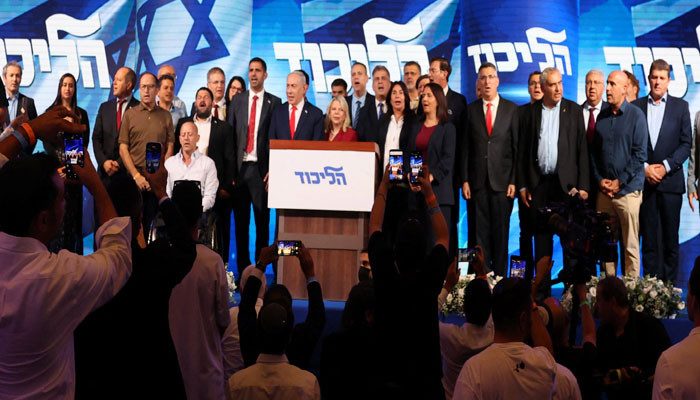
Israelis cast their ballots on Tuesday in the highest voter turnout recorded in decades, leaving the political future of the country uncertain as exit polls showed Prime Minister Benjamin Netanyahu and his rival in a dead heat. Three major television networks reported that both the incumbent and the opposition bloc led by former army chief Gadi Eisenkot secured approximately 51 seats each in the 120-member Knesset.
This result fell significantly short of the 61 seats required to form a governing majority. Exit polls showed both Netanyahu and Eisenkot blocs tied with 51 seats each.
Arab Israeli lists performed strongly, securing a combined total of 17 or 18 seats. President Isaac Herzog holds the authority to designate a candidate to form a government.
The path to a stable government remains unclear as parties begin immediate negotiations. President Isaac Herzog will select a candidate who possesses the best chance of building a coalition, regardless of which party holds the most seats.
While Arab Israeli parties, specifically Raam, expressed openness to collaborating with Eisenkot, his camp maintained distance during the campaign to avoid political liability. Netanyahu faces his own challenges, as several smaller right-wing parties failed to meet the threshold for parliamentary entry, leaving him with few options to expand his bloc.
Coalition talks in Israel are historically arduous and often result in unstable administrations. It took Netanyahu 58 days to assemble his government following the November 2022 election.
If neither side secures 61 seats, a candidate might attempt to govern through ad hoc support from other lawmakers. In this arrangement, Arab Israeli parties could serve as critical kingmakers.
Mansour Abbas, leader of the Raam party, previously participated in a 2021-2022 coalition led by Naftali Bennett and Yair Lapid. The Joint List, another Arab movement, indicated it might provide a safety net to oust Netanyahu but remains unlikely to join a coalition outright.
Political commentator Tal Elovitz noted that the high Arab turnout reflected a strong desire for partnership. Elovitz stated that a minority government led by Eisenkot remains a possibility, though the final outcome depends on the official vote count.
While extreme polarization makes a national unity government appear unlikely, some observers suggest Netanyahu could theoretically discard his far-right and ultra-Orthodox allies to partner with Eisenkot. Such a coalition would exclude Arab parties and align with the preferences of 55 percent of voters polled on October 16.
If all efforts to form a government fail, Israel faces the prospect of returning to the polls. The country conducted four elections between April 2019 and March 2021 due to similar legislative deadlocks.
The designated candidate typically receives 28 days to form a coalition, with a potential 14-day extension. The nation now waits for the official tally to determine the next steps in this complex political landscape.