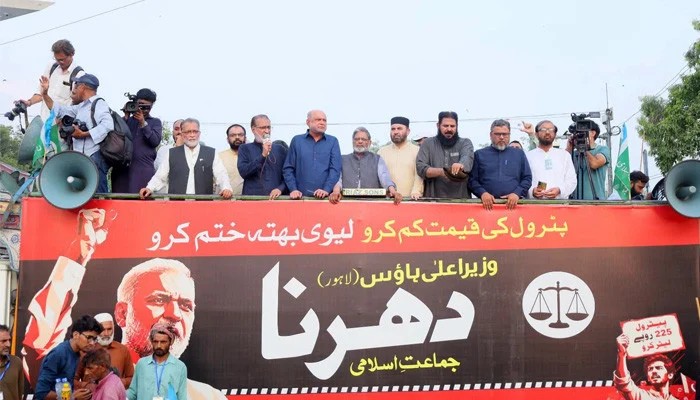
(Jamaat-e-Islami) began its latest round of protests and sit-ins in Karachi, Lahore, Peshawar and Quetta on Sunday against the petroleum levy, rising petroleum product prices and rising inflation. The protests formed the next phase of the party's nationwide campaign after demonstrations were held at hundreds of locations earlier this month. In Lahore, Jamaat-e-Islami workers continued their sit-in at Faisal Chowk on Mall Road.
The protesters had marched along Mall Road before reaching Faisal Chowk near the Chief Minister's House. Punjab Jamaat-e-Islami chief Javed Qasuri and other party leaders participated in the demonstration, while Jamaat-e-Islami Emir Hafiz Naeemur Rehman also reached the sit-in. Addressing the protesters, Hafiz Naeem said that a sit-in was also continuing outside the Governor House in Karachi.
He criticised the government over rising petroleum prices and taxes, saying the rulers had created difficulties for the people. Hafiz Naeem said the government was not only increasing petrol prices but also raising taxes. He described the petroleum levy as a "extortion tax" and "jagga tax", and questioned how many landlords associated with the Pakistan Muslim League-Nawaz (Pakistan Muslim League-Nawaz (PML-N)) had paid taxes on their agricultural lands.
He also demanded that the government reduce the petrol price to Rs225 per litre. "Bring the price of petrol down to Rs225," the Jamaat-e-Islami emir said. He said the feudal system would not continue, accusing landlords of exploiting poor farmers.
"There is a group imposed on us," he said, criticising what he described as the government's economic policies. The Jamaat-e-Islami emir also said the salaried class had paid around Rs700 billion in taxes, while questioning the distribution of the tax burden across different sections of society. In Karachi, Jamaat-e-Islami workers marched from different areas of the city towards Governor House.
Led by Jamaat-e-Islami Karachi chief Munim Zafar, the protesters reached Governor House and staged a sit-in outside against the petroleum levy and rising fuel prices. Police were deployed around Governor House as protesters gathered in the area. Authorities said the road from Fawara Chowk towards the Press Club and Arts Council remained open to traffic.
Addressing the protesters from a makeshift stage on a truck outside the Governor House, Jamaat-e-Islami Karachi chief Monem Zafar warned the Sindh government and police against using force to stop the sit-in. "If the government chooses the path of violence and force, it will be responsible for the consequences," he said, insisting that the sit-in would continue. He said the high price of petrol is affecting every citizen and every sector of the economy, saying that young people and students were effectively paying around Rs130 per litre in petroleum levy.
"The Jamaat-e-Islami's sit-in is the voice of every young person, student and citizen," he said. Referring to Prime Minister Shehbaz Sharif's earlier statements about resolving Karachi's water crisis, he criticised the prime minister's visit to the city, saying he had arrived with a large protocol convoy but failed to resolve its longstanding issues. He said the Jamaat-e-Islami would continue its campaign for the rights of Karachi's residents and against what he termed an unjust system.
In Peshawar, Jamaat-e-Islami workers staged a sit-in outside the Governor House, leading to the closure of the road between Saddar and Khyber Pakhtunkhwa Assembly Chowk. Jamaat-e-Islami Deputy Emir Liaquat Baloch was scheduled to address the protesters. The party also organised a sit-in in Quetta as part of its simultaneous protests across the four provinces.
Jamaat-e-Islami leadership had previously announced demonstrations outside the Punjab Chief Minister's House and the governor houses in Sindh, Khyber Pakhtunkhwa and Balochistan. Addressing a press conference in Peshawar on August 8, Jamaat-e-Islami Emir Hafiz Naeemur Rehman had said the government was relying on the petroleum levy to generate revenue while shifting the burden onto ordinary citizens. The party has demanded relief from high fuel prices and inflation and has also criticised what it describes as excessive privileges and spending by the ruling elite.
The latest protests followed Jamaat-e-Islami's nationwide demonstrations last week, when the party staged rallies, sit-ins and road blockades at hundreds of locations against inflation, rising fuel prices, the petroleum development levy and higher taxes. The party said the protests were intended to increase pressure on the federal government to provide relief to people facing a growing cost-of-living burden.