
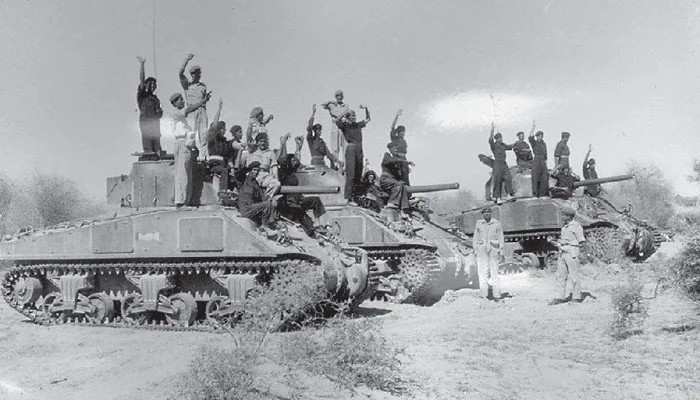
There are moments in a nation's history when the ordinary rhythm of life is suddenly replaced by an extraordinary test of courage. September 6, 1965, was one such moment for Pakistan. It was a routine Sunday in Lahore when news arrived that Indian forces had crossed the international border and were advancing towards the city.
What followed was not merely a military confrontation but a remarkable national courage. As soldiers moved towards the front, civilians supported them with food, prayers and unwavering resolve. Lahore and Sialkot endured air attacks with remarkable courage, while patriotic songs and wartime broadcasts strengthened national morale.
For millions, September 1965 became a defining moment of unity, sacrifice and resilience, demonstrating the extraordinary strength of a nation that stands together in defence of its motherland. The circumstances surrounding the war make the response of Pakistan's armed forces even more significant. Tensions had already been rising following clashes in the Rann of Kutch and continued exchanges along the Kashmir front.
Yet the scale of the Indian offensive across the international border required Pakistan to respond under immense pressure. Indian planners had expected surprise to provide them with a decisive advantage, while the political and military leadership in New Delhi anticipated a rapid advance towards Lahore. Instead, the attacking forces encountered determined resistance.
Pakistani troops moved swiftly to their defensive positions, while the Pakistan Air Force responded with remarkable speed and effectiveness. The PAF disrupted the Indian advance, while the Pakistan Army held its ground against a numerically superior adversary. The Pakistan Navy further demonstrated its reach by striking Indian facilities at Dwarka.
While heroes such as Squadron Leader M M Alam became symbols of the war, thousands of servicemen fought with equal courage, many without ever being recognised by name. Together, the Army, Air Force and Navy demonstrated that preparedness, determination and strategic initiative can overcome numerical superiority. Yet perhaps the most enduring feature of 1965 was what happened away from the battlefield.
The defence of Pakistan became a collective national effort. Citizens supported soldiers with food and supplies, communities endured blackouts and air raids, while Lahore and Sialkot, which faced intense attacks, became symbols of civilian courage and were awarded the Hilal-e-Istaqlal. The soldier at the front knew that an entire nation stood behind him.
That unity remains one of the defining lessons of the September War: when Pakistan faced aggression, its people stood together with its armed forces. The passage of time has changed the nature of warfare, but it has not changed the fundamental responsibility of Pakistan's armed forces. The India-Pakistan rivalry has continued through subsequent decades, and the security challenges facing Pakistan have become more complex, extending from conventional threats to terrorism, militancy and information warfare.
Pakistan has repeatedly raised concerns over militant activity originating from Afghan territory and alleged hostile attempts to exploit instability inside the country. These challenges have required the armed forces to remain prepared on multiple fronts rather than concentrating exclusively on a conventional battlefield. The experience of 1965 established a principle that remains relevant even today: Pakistan's security cannot depend on assumptions about an adversary's intentions; it must rest on preparedness, vigilance and the capacity to respond.
This is where the significance of Marka-e-Haq in 2025 becomes relevant. The battlefield may have changed dramatically since 1965, but the underlying test did not. Whether facing a conventional military threat or a more complicated combination of military, technological and asymmetric challenges, Pakistan's armed forces have continued to demonstrate their readiness to defend the country.
1965 showed one generation that Pakistan could withstand a major military challenge; Marka-e-Haq showed a new generation that this readiness has not disappeared with time. For the generation that lived through 1965, the memories remain deeply personal: the sound of air raid sirens, the anxiety of families waiting for news from the front, the excitement surrounding wartime broadcasts and the pride inspired by the country's defenders.
The younger generation may know much of 1965 through history books and stories told by parents and grandparents, but Marka-e-Haq is likely to remain its own living memory of national defence. That is the most powerful connection between the two moments. Sixty years may separate them, but the central message remains unchanged.